*I had made a post under this title yesterday, but I accidentally deleted it when trying to delete something else! So here it is again, or what I can remember of it*
Being less than mobile recently, thanks to a knee injury, I have been doing a bit more reading than usual. I have been looking through my collection of Deep Sky Magazine and an article by Jeffrey Corder in DSM #6 Spring 1984, titled 'Observing Low Surface Brightness Objects', contained a sentence that caught my eye. The sentence in question read: "The reason old Reverend Webb described M33 as "Large, faint, and ill-defined" was more because his notoriously damp homeland of England is a generally poor site than because M33 is especially difficult".
Er, "...generally poor site"? That's a sweeping statement if ever I saw one and, like all sweeping statements, is actually not entirely true. Okay, England isn't great, but neither is it a 'generally poor site' and, apart from the north-west, a lot of it isn't 'notoriously damp' either, especially in the south.
Arizona is 'great', West Texas is 'great' (when it isn't on fire), the outback of Australia is 'great', Chile's Atacama Desert is 'great' and so on, but most observers - most people - don't live in these observational nirvanas, they live in areas that are as cloudy and as light polluted as England, so it does kind of annoy me when I hear and read remarks such as Jeffrey's and 'Soggy little Britain', which an American friend said to me on Facebook recently.
I used to be under the impression that people in the US, especially, had pristine home skies and spent all their spare evenings observing, so I was a little jealous! My visits to the Texas Star Party, and also reading forums such as Cloudy Nights, actually proved otherwise as most people live in areas which are cloudy and/or light polluted. People have to live in or near towns and cities for work, unless they happen to be rich or retired, and really only get dark sky observing opportunities around new Moon if the weather co-operates and they can get out of town for a night or two.
While 300+ clear nights a year would be nice, we don't do too badly here, with over 100 nights a year, give or take a few, that are observationally usable - if we ignore the Moon's phase - most particularly here on the South Coast where high sunshine levels translate into a decent amount of clear nights. I've been keeping a record of nights that are usuable for observing (partly clear as well as 100% clear) and, so far, in 2011, we've had 69 nights out of 155 that have been clear or partly clear, despite the coldest and cloudiest winter for 40 years. That's 44%, not too shabby for a 'generally poor site'. Out of those 69 nights, 52 have been totally clear. 2010 was 46% clear or partly clear (33% totally clear). Anything less than 50% clear goes down as cloudy! 50% clear is usable and I often observe on partly clear nights, as long as the Moon isn't in the way. I have to admit that even I don't observe as much as I could, as it isn't always possible, particularly in the summer when nights are very short and in mid-winter when sub-zero temperatures make it a test of endurance, and at the age of 41 I'm beginning to find that several nights in a row is hard going, particularly when I am also working during the day.
That said, the weather does have a habit of being inclement when there's an astronomical event on. Planning a public session to view an eclipse? You can bet it will probably be cloudy! However, the same goes for the USA, outside the dry and clear south west, and other countries, too. If you plan your observing around weekends because of work, particular dates or events, then there is a risk it will be cloudy or wet, as such a narrow window of opportunity means the perspective will be skewed. It doesn't mean that it's always or even mostly cloudy and wet.
Even the Texas Star Party this year wasn't an observational success, as they were clouded out for all except two-and-a-half nights. Nearby range fires, caused by lighting strikes, haven't helped either. A few past TSPs have been a bit hit-and-miss, too with 1992, 2005 and 2007 being pretty bad.
It's a bit of a ramble but what I am trying to say here is that people tend to criticise England (and Britain in general) rather unfairly, when the truth isn't as bad and it does annoy me, particularly when it often comes from people who are no better off than we are. It's true that we British do love to complain about the weather but as whingeing is a national pastime here (and, yes, I can moan with the best of 'em!), that doesn't mean much, as sunshine and 90 degree temperatures here bring as many complaints from people as any other type of weather! In short, while we don't have the best observing conditions here by no means do we have the worst either. England is probably about average in the grand scheme of things.
Light pollution is more of a menace than clouds. The UK, especially England, is overcrowded and, as such, is quite badly light polluted and we have a big problem here in that respect. Public ignorance is a major factor in this as they tend to think that turning night into day is somehow a 'good thing' and prevents crime. It isn't and doesn't. It's wasteful, adds to carbon emissions and isn't proven to reduce crime - and criminals need light to see, they don't have superior night vision compared to the rest of us!
Local council street light switch-offs, due to austerity measures, have been greated with bleating about 'blackouts' and claims of increased crime (although that's not supported by facts) and one woman in Northamptonshire claimed she fell over in the dark and injured herself. You don't just 'fall over' in the dark unless you're not taking adequate care and using a torch, unless you have a problem. It's the same with pedestrians walking along unlit roads at night - if they wear light or reflective clothing then they have far less chance of being run over, unless they do something really stupid.
The battle against light pollution is slowly gaining some ground with a lot of councils, including the Isle of Wight, beginning to put new LED lamps in. Apparently, these shine downwards and little or no light actually goes into the sky. I have read reports where amateur astronomers in areas where these have already been installed say that there is a big improvement. It's a step in the right direction and, if these lights shine where they are supposed to but the sky remains dark, then everyone will be happy. Light trespass is now an offence, so badly shielded and directed security lights have to be adjusted if a complaint is made.
Returning to Jeffrey Corder's article, as for M33 itself from here it's certainly large but it's not a hard object to see. It's a naked-eye object on a good night from here and is not that faint or ill-defined, being a nice sight in binoculars. Telescopically there's lots to see such as HII areas and, with a large enough scope, globular clusters.
Rev. Webb's impression of it was more likely down to the quality - or lack of it - of his scopes rather than any shortcomings in the quality of his sky. I daresay that telescopes back in 1984 were superior to those of the 1800s, which was Webb's era.
Showing posts with label Weather. Show all posts
Showing posts with label Weather. Show all posts
Sunday, 5 June 2011

Tuesday, 24 May 2011
Deja vu
Volcanic ash. Again. At least, this year, I don't have any travel plans to be potentially disrupted but if I was going to TSP, I think I'd be a bit worried, as it starts on Sunday. I was lucky last year, I dodged the ash as the winds changed direction the day before my flight left and the worst thing that happened then was that we got rerouted north of the Arctic Circle, which turned an 8 hour flight into a 12 hour flight. Who'd have bet on lightning - or, rather, ash - striking twice in the space of 13 months when there's been hitherto years of no disruption despite plenty of Icelandic volcanic activity?
On a lighter note, I am hoping to do some travelling next year, whether the TSP or something else. I am thinking of doing something different and going on an astronomy trip to Arizona. Arizona has a fabulous climate for observers, being dry and transparent with over 300 clear nights a year (which is a lot better than us!), there are observatories you can visit - Lowell certainly has a public visitor centre - and there are, as you'd imagine, lots of amateur astronomers and astronomy clubs there. Also, while I have been to the States three times, all of these visits have been to Texas and I'd like to see a bit more of the place. It's a big country and there is plenty to see. Should I make it out to Arizona, I am hoping I can meet with other observers and clubs. Funds permitting, I would also be hoping to make a side-trip to California.
I'd like to take a little travel scope with me as my 8x42 binoculars don't quite cut it, although they are great for widefield views and I have seen most of the Messiers and quite a few brighter non-Messier DSOs with them. I have a Vixen 70mm guidescope that came in a box of bits given to me a few years ago and that should fit the bill quite nicely. I have found a suitable 1.25 inch diagonal and my Televue 25mm, 15mm and 11mm Plossls plus the 8mm Radian (which give magnifications of 16.8x, 28x, 38x and 52.5x respectively) and it gives nice views of bright deep sky objects and the Milky Way. I am not sure I'd take all four eyepieces with me but it's nice to have a variety.

I tried it out last night, on M4, M57, M81, M82 and the globulars in Ophiuchus and it worked very well indeed.
I also had a fairly unsuccessful session with the 12". Unsuccessful? Simply because the sky was a bit too light (it was 2330 local time) to find much, there was a fair bit of drifting cloud around and there was a stiff breeze (it has been pretty stormy just recently). I was after galaxies in Hercules, knowing full well it wouldn't be that successful. Hercules is best placed for viewing in June but that's precisely the wrong time of year to see it properly from these latitudes, thanks to light nights.
I did, however, find NGC 5970, a galaxy in Serpens (Caput) - it was reasonably bright and stood out well against the background sky. There wasn't much brightening towards the core, it was very slight. Core non-stellar and the edges of the galaxy were diffuse, not sharp. Elongated 2:1 NW-SE. 69x, 190x
I then had a look round some of the brighter Messier globulars in Ophiuchus before putting the 12" away and getting out the little 70mm Vixen.
On a lighter note, I am hoping to do some travelling next year, whether the TSP or something else. I am thinking of doing something different and going on an astronomy trip to Arizona. Arizona has a fabulous climate for observers, being dry and transparent with over 300 clear nights a year (which is a lot better than us!), there are observatories you can visit - Lowell certainly has a public visitor centre - and there are, as you'd imagine, lots of amateur astronomers and astronomy clubs there. Also, while I have been to the States three times, all of these visits have been to Texas and I'd like to see a bit more of the place. It's a big country and there is plenty to see. Should I make it out to Arizona, I am hoping I can meet with other observers and clubs. Funds permitting, I would also be hoping to make a side-trip to California.
I'd like to take a little travel scope with me as my 8x42 binoculars don't quite cut it, although they are great for widefield views and I have seen most of the Messiers and quite a few brighter non-Messier DSOs with them. I have a Vixen 70mm guidescope that came in a box of bits given to me a few years ago and that should fit the bill quite nicely. I have found a suitable 1.25 inch diagonal and my Televue 25mm, 15mm and 11mm Plossls plus the 8mm Radian (which give magnifications of 16.8x, 28x, 38x and 52.5x respectively) and it gives nice views of bright deep sky objects and the Milky Way. I am not sure I'd take all four eyepieces with me but it's nice to have a variety.

I tried it out last night, on M4, M57, M81, M82 and the globulars in Ophiuchus and it worked very well indeed.
I also had a fairly unsuccessful session with the 12". Unsuccessful? Simply because the sky was a bit too light (it was 2330 local time) to find much, there was a fair bit of drifting cloud around and there was a stiff breeze (it has been pretty stormy just recently). I was after galaxies in Hercules, knowing full well it wouldn't be that successful. Hercules is best placed for viewing in June but that's precisely the wrong time of year to see it properly from these latitudes, thanks to light nights.
I did, however, find NGC 5970, a galaxy in Serpens (Caput) - it was reasonably bright and stood out well against the background sky. There wasn't much brightening towards the core, it was very slight. Core non-stellar and the edges of the galaxy were diffuse, not sharp. Elongated 2:1 NW-SE. 69x, 190x
I then had a look round some of the brighter Messier globulars in Ophiuchus before putting the 12" away and getting out the little 70mm Vixen.
Sunday, 27 March 2011
Clear skies 2010
As some of you might recall, I've been keeping a (admittedly probably unscientific) spreadsheet of clear skies vs cloudy ones (I've had friends and relatives keep a note of sky conditions when I have been away, such as at TSP). I've made a note of clear skies, partly cloudy ones, and totally cloudy ones. Clear and partly clear both mean observationally usable ones as, even when partly clear you can still do some observing, even if it's with a pair of binoculars or half an hour with the scope.
According to my spreadsheet, 2010 had 111 totally clear nights, which is 30% of the total nights of the year. That's nearly one third which, considering a lot of people think the UK has a largely unfavourable climate is better than you'd think, and that's despite the horrible harsh and cloudy winter we've just had.
Clear and partly clear, added together, comes to 169 nights or 46%. That's getting on for HALF of the nights here in this part of England being usable for astronomy during 2010. Quite a surprise. Unfortunately, as ever, there's a caveat - the clearest time is May, June and July when all-night astronomical twilight keeps deep sky observing to a minimum. However, I will make a resolution to use those nights to observe and sketch the brighter DSOs, such as the Messier and brighter NGC nebulae and clusters, rather than just waste them. Maybe I will observe the planets, if any are around, as well. It will be a nice throw back to the time, 19 years ago, when I first got into observing and observed all through the summer twilight - my observing notes throughout the 1990s and early 2000s go right through June and July, no complaints about the twilit nights there!
So far in 2011, 24% of nights have been clear and 29% have been clear or partly clear, mostly during March. I will admit to not taking full advantage of them, mostly because they have coincided with the Moon's gibbous and full phases.
Looking at all the clear skies we've had - and I hope 2011 and beyond follow suit - I am going to make more of an effort to make use of them. It's not always possible to use every clear night, of course, as life tends to get in the way, as does tiredness and - let's be honest - laziness, but using half or more would be great.
Yep, Britain has got a reputation for being fairly useless astronomy-wise but - and it does depend on where you live, as we have a varied climate for such a small archipelago - it's not quite as bad as some people think. Most people work the usual 9am-5pm Monday to Friday routine and, as such, can only observe at weekends and on vacations, so they tend only to look at the sky then. That tends to give the impression that it's semi-permanently cloudy, as they are only looking through a small window of time so, statistically it's bound to give a skewed impression.
I am lucky though, in that I live in one of the clearest areas of Britain. The Isle of Wight, just off the south coast, has got one of the highest sunshine totals of anywhere in the country and this also means more clear nights. No, the UK isn't brilliant and we'd all like 300+ clear nights a year but you'd have to move to somewhere like Arizona for that - although I don't deny that if the opportunity presented itself I'd be off like a shot!
According to my spreadsheet, 2010 had 111 totally clear nights, which is 30% of the total nights of the year. That's nearly one third which, considering a lot of people think the UK has a largely unfavourable climate is better than you'd think, and that's despite the horrible harsh and cloudy winter we've just had.
Clear and partly clear, added together, comes to 169 nights or 46%. That's getting on for HALF of the nights here in this part of England being usable for astronomy during 2010. Quite a surprise. Unfortunately, as ever, there's a caveat - the clearest time is May, June and July when all-night astronomical twilight keeps deep sky observing to a minimum. However, I will make a resolution to use those nights to observe and sketch the brighter DSOs, such as the Messier and brighter NGC nebulae and clusters, rather than just waste them. Maybe I will observe the planets, if any are around, as well. It will be a nice throw back to the time, 19 years ago, when I first got into observing and observed all through the summer twilight - my observing notes throughout the 1990s and early 2000s go right through June and July, no complaints about the twilit nights there!
So far in 2011, 24% of nights have been clear and 29% have been clear or partly clear, mostly during March. I will admit to not taking full advantage of them, mostly because they have coincided with the Moon's gibbous and full phases.
Looking at all the clear skies we've had - and I hope 2011 and beyond follow suit - I am going to make more of an effort to make use of them. It's not always possible to use every clear night, of course, as life tends to get in the way, as does tiredness and - let's be honest - laziness, but using half or more would be great.
Yep, Britain has got a reputation for being fairly useless astronomy-wise but - and it does depend on where you live, as we have a varied climate for such a small archipelago - it's not quite as bad as some people think. Most people work the usual 9am-5pm Monday to Friday routine and, as such, can only observe at weekends and on vacations, so they tend only to look at the sky then. That tends to give the impression that it's semi-permanently cloudy, as they are only looking through a small window of time so, statistically it's bound to give a skewed impression.
I am lucky though, in that I live in one of the clearest areas of Britain. The Isle of Wight, just off the south coast, has got one of the highest sunshine totals of anywhere in the country and this also means more clear nights. No, the UK isn't brilliant and we'd all like 300+ clear nights a year but you'd have to move to somewhere like Arizona for that - although I don't deny that if the opportunity presented itself I'd be off like a shot!
Sunday, 14 November 2010
Still here
I am still here, although I have done absolutely zero observing since 11th October, due mainly to near-endless clouds and rain. We've had a month's rain alone this past week and force 9 gales, gusting to storm force 10 on Tuesday and Thursday but, luckily, my observing shed has held up well in the face of the violent weather, it's still standing and has let in no water, despite the combination of force 10 gusts and horizontal, torrential rain.
The only astronomy-related thing I have done recently is, with a fellow member of VAS, a talk at a primary school about astronomy. Children are not my favourite demographic as I don't really have any real rapport with them, but it was an enjoyable evening, nonetheless, with a good turnout despite the atrocious weather and the kids, although they could fidget for England (one was totally hyperactive and slightly annoying) were interested, surprisingly knowledgeable - except one who said that loads of security lights and street lamps were a good thing! - and asked some good questions. Even their parents didn't ask stupid questions! It had originally been planned to be an observing session but conditions were downright dangerous outside with severe gales and flying debris, so it was downscaled to a presentation istead.
The reason I was there was that, during a committee meeting of VAS (the first after the AGM) they needed what is rather grandly titled 'Outreach and events liason officer' and asked for volunteers. None were forthcoming and I - reluctantly, it has to be said as I am not into outreach whatsoever; I can see the value of it, but it is not for me because on a clear night, I'd rather be doing my own thing - agreed to take on the role. So, I have to be seen to go to the events.
It's Remembrance Sunday and I'm watching the Cenotaph coverage on BBC1. The sheer scale of death and destruction caused by war just goes to show how pointlessly stupid war is, and how insanely destructive the human species can be. We trash the environment, we kill other species and we fight endlessly over ridiculous things such as religion, land and one country looking at another the wrong way. It's politicians who are stupid, not the sailors, soldiers and airmen who have to fight the wars; the armed forces are, as someone once said, "lions led by donkeys".
Not only that, we're in constant danger, if the goverment and media are to be believed, of being blown up by brainwashed morons and lunatics with a warped view of Islam. How can a species - us - that does fantastic things such as space travel, science (when it is not abused), astronomy, make music and build great ships, etc, also be such a stupid one? We are obviously not as advanced or as civilised as we like to think we are. Maybe one day, we'll grow up a bit.
And that's my 'deep' bit for this year. And I'm not usually as misanthropic as this either! Oh, and the 'Last Post' gets you *right there* doesn't it?
On a more cheerful note, after the largely downbeat nature of this post, I am tentatively planning a trip to the southern hemisphere at the end of next year or beginning of 2012. I want to see the southern sky again and, as the 20" plans are unlikely to happen for a long time for various reasons, I have decided to do the cheaper option. I'm considering Australia again and I'd like to go during their summer (our winter) for two reasons. Firstly, I'd like to see the southern summer skies, which I have not done and, secondly, escaping least one crappy, dismal UK winter is an appealing prospect if only for three or four weeks. The Aussie weather should, at least, be better in November-February than it was in May last year and, in any case, will be far better than the cold, wind and rain of north-western Europe.
Also, I am giving a talk at the Webb Deep Sky Society AGM in Cambridge on 4th December. Owen Brazell emailed me and asked if I'd be prepared to give a talk about the Texas Star Party so I thought 'why not?' and agreed. I'll do it as a Power Point presentation with loads of pictures of big scopes, scenery and night skies. Getting to Cambridge is a pain from the Isle of Wight but, hopefully, I can get a lift up there. I'm looking forward to it, actually, because I have not been to a Webb meeting since 2005 and it will be nice to catch up with people again.
The only astronomy-related thing I have done recently is, with a fellow member of VAS, a talk at a primary school about astronomy. Children are not my favourite demographic as I don't really have any real rapport with them, but it was an enjoyable evening, nonetheless, with a good turnout despite the atrocious weather and the kids, although they could fidget for England (one was totally hyperactive and slightly annoying) were interested, surprisingly knowledgeable - except one who said that loads of security lights and street lamps were a good thing! - and asked some good questions. Even their parents didn't ask stupid questions! It had originally been planned to be an observing session but conditions were downright dangerous outside with severe gales and flying debris, so it was downscaled to a presentation istead.
The reason I was there was that, during a committee meeting of VAS (the first after the AGM) they needed what is rather grandly titled 'Outreach and events liason officer' and asked for volunteers. None were forthcoming and I - reluctantly, it has to be said as I am not into outreach whatsoever; I can see the value of it, but it is not for me because on a clear night, I'd rather be doing my own thing - agreed to take on the role. So, I have to be seen to go to the events.
It's Remembrance Sunday and I'm watching the Cenotaph coverage on BBC1. The sheer scale of death and destruction caused by war just goes to show how pointlessly stupid war is, and how insanely destructive the human species can be. We trash the environment, we kill other species and we fight endlessly over ridiculous things such as religion, land and one country looking at another the wrong way. It's politicians who are stupid, not the sailors, soldiers and airmen who have to fight the wars; the armed forces are, as someone once said, "lions led by donkeys".
Not only that, we're in constant danger, if the goverment and media are to be believed, of being blown up by brainwashed morons and lunatics with a warped view of Islam. How can a species - us - that does fantastic things such as space travel, science (when it is not abused), astronomy, make music and build great ships, etc, also be such a stupid one? We are obviously not as advanced or as civilised as we like to think we are. Maybe one day, we'll grow up a bit.
And that's my 'deep' bit for this year. And I'm not usually as misanthropic as this either! Oh, and the 'Last Post' gets you *right there* doesn't it?
On a more cheerful note, after the largely downbeat nature of this post, I am tentatively planning a trip to the southern hemisphere at the end of next year or beginning of 2012. I want to see the southern sky again and, as the 20" plans are unlikely to happen for a long time for various reasons, I have decided to do the cheaper option. I'm considering Australia again and I'd like to go during their summer (our winter) for two reasons. Firstly, I'd like to see the southern summer skies, which I have not done and, secondly, escaping least one crappy, dismal UK winter is an appealing prospect if only for three or four weeks. The Aussie weather should, at least, be better in November-February than it was in May last year and, in any case, will be far better than the cold, wind and rain of north-western Europe.
Also, I am giving a talk at the Webb Deep Sky Society AGM in Cambridge on 4th December. Owen Brazell emailed me and asked if I'd be prepared to give a talk about the Texas Star Party so I thought 'why not?' and agreed. I'll do it as a Power Point presentation with loads of pictures of big scopes, scenery and night skies. Getting to Cambridge is a pain from the Isle of Wight but, hopefully, I can get a lift up there. I'm looking forward to it, actually, because I have not been to a Webb meeting since 2005 and it will be nice to catch up with people again.
Friday, 1 October 2010
Parapher...parerfern...observing stuff
While I like to keep observing simple, none of that fiddly imaging stuff for me(!), I do still end up taking quite a bit of observing paraphernalia with me every observing session. I keep my eyepieces in the house, as well as my notebooks, etc, for security and also so they don't get damp. My Star Atlas 2000.0 stays in a box in the shed, it's already got damp on numerous occasions, is a bit mouldy in places and is eminently un-nickable.
Here are the items - apart from my scope - that I use each time I go observing:
A bag to put everything (excluding eyepieces) in:

A ring-binder for my observing lists and printed MegaStar charts:

Sketchbook:

Notebook (for those times where I don't do sketches although it comes every session as it's also a logbook for each session):


Sketching/writing stuff. Pens, pencils - mechanical pencils and graphite sticks - chamois for smudging nebulae, etc), tortillon, clip-on red torch, round template for sketches (plastic lid off coffee cup), putty eraser and eraser shield, all stored in a handy artist's case which I got from a local art shop:

The Night Sky Observers Guide; if I do take them out I usually only take one out at a time and I use them for checking observations afterwards, although normally I wait until I get back indoors. Before I had the shed, I would never take them outside, too expensive to ruin!

The all-important dim red torch. This one has adjustable LEDs.

And my case of eyepieces and other scope bits and pieces:

The bits and pieces, except the Night Sky Observer's Guides which stay on my bookshelf, are kept in the bag and it, the case and a flask of tea or coffee, get carried up the garden in one go; I can carry all that lot at once, because the bag has a shoulder strap, so unless I've forgotten something, I don't need to return to the house.
The weather is currently atrocious and I've not been observing for a while. I did get out last week, around full Moon when it was (typically!) clear and looked at Jupiter and Uranus with my 3.5" refractor; with enough magnification I managed to see Uranus as a disk, which was good. That was an interesting diversion but I've done no deep sky since the early morning of September 17th.
This was the dismal view from the kitchen window this afternoon, and there's at least another week of this crap to come, due to deep lows in the Atlantic (sometimes I find myself wishing the damn thing would dry up!). Fortunately my observing shed, in the far distance in the photo, appears to be holding up in the face of the gales and rain. Touch wood!

Here are the items - apart from my scope - that I use each time I go observing:
A bag to put everything (excluding eyepieces) in:

A ring-binder for my observing lists and printed MegaStar charts:

Sketchbook:

Notebook (for those times where I don't do sketches although it comes every session as it's also a logbook for each session):


Sketching/writing stuff. Pens, pencils - mechanical pencils and graphite sticks - chamois for smudging nebulae, etc), tortillon, clip-on red torch, round template for sketches (plastic lid off coffee cup), putty eraser and eraser shield, all stored in a handy artist's case which I got from a local art shop:

The Night Sky Observers Guide; if I do take them out I usually only take one out at a time and I use them for checking observations afterwards, although normally I wait until I get back indoors. Before I had the shed, I would never take them outside, too expensive to ruin!

The all-important dim red torch. This one has adjustable LEDs.

And my case of eyepieces and other scope bits and pieces:

The bits and pieces, except the Night Sky Observer's Guides which stay on my bookshelf, are kept in the bag and it, the case and a flask of tea or coffee, get carried up the garden in one go; I can carry all that lot at once, because the bag has a shoulder strap, so unless I've forgotten something, I don't need to return to the house.
The weather is currently atrocious and I've not been observing for a while. I did get out last week, around full Moon when it was (typically!) clear and looked at Jupiter and Uranus with my 3.5" refractor; with enough magnification I managed to see Uranus as a disk, which was good. That was an interesting diversion but I've done no deep sky since the early morning of September 17th.
This was the dismal view from the kitchen window this afternoon, and there's at least another week of this crap to come, due to deep lows in the Atlantic (sometimes I find myself wishing the damn thing would dry up!). Fortunately my observing shed, in the far distance in the photo, appears to be holding up in the face of the gales and rain. Touch wood!

Monday, 13 September 2010
Observing 12/13th September 2010
'I got the poison, I got the remedy, I got the pulsating rhythmical remedy'
...so goes the lyric of Prodigy's song Poison, and fairly appropriate as they were coming down the valley loud and clear from the 'Bestival' last night - also appropriate as I found a Death Cap toadstool in the garden yesterday, which I promptly threw in the bin out of reach of the dogs (DCs are the most poisonous toadstools known). I like the Prodigy, but I don't like the light pollution from the festival that was wiping out the north western, and most of the western, sky or Rob da Bank's DJ set of bad music that went on to almost 4am this morning (1am's fine, but later than that is not. I bet they've pissed off the entire Arreton valley). At least that's over for another year.
The weather forecast called for it to clear at sunset, the BBC (Met Office) said it would be clear all night but the others (Accuweather, Metcheck and The Weather Outlook) disagreed, forecasting it to be partly clear, and, in the end, they were right and the BBC were wrong.
Conditions: Cool, but not cold, some drifting clouds at first, becoming murkier later. Slight dew.
Seeing: Ant II, very good
Transparency: III to IV later (III. Clear, some haze visible. Milky Way still visible but not detailed; IV. Milky skies, moderately hazy but observing of brighter NGCs doable/drifting cloud).
Equipment: 12" f/5 dob, 22mm Televue Panoptic (69x), 15mm Televue Plossl (101x), 8mm Televue Radian (190x), OIII filter. MegaStar 5 chart printouts, Sky Atlas 2000.0, Pocket Sky Atlas and NSOG Vols I and II
NGC 6996, open cluster in Cygnus - Located within NGC 7000 (the North America Nebula). Spiral shaped cluster of 30+ fairly faint stars. Spiral is anti-clockwise. Fainter stars among the brighter ones. Chain loops off to north before turning west. Quite large. Moderately rich. Observation interfered with by drifting clouds. 69x.
NGC 6824, galaxy in Cygnus - People think of Cygnus as a realm of open clusters, PNes and nebulae, but galaxies lurk here too. Fairly bright and easy to find as it stands out against the background sky. Almost round. Brightens gradually towards the core. Core diffuse, not bright. 69x, 190x.
NGC 6894, planetary nebula in Cygnus - A bit of a sod to find, faint and quite small. Not helped by milky sky. At low power, there is a hint of something fuzzy and oval. An OIII filter brings it out as a filled-in oval. At high power, and with the OIII, it has a darker middle and looks annular. 69x, 190x, OIII filter.
The latter observation was being affected by the fireworks from the festival, I could see the flashes in the eyepiece while looking at NGC 6894, which was hard enough to see as it was. So I abandoned Cygnus and moved over to Triangulum and Aries, which were just clearing next door's oak trees from my position.
NGC 772, galaxy in Aries - Round, quite faint (low), condenses to non-stellar, but obvious, core. 69x, 101x.
NGC 672, galaxy in Triangulum - Quite faint, elongated west-east. No brightening in centre. Faint halo around bar. IC 1727 nearby but very faint that I want another look at it on a better night. 69x, 101x, 190x.
NGC 925, galaxy in Triangulum - Elongated, faint. Evenly bright with halo. Some foreground stars. 69x, 190x
NGC 890, galaxy in Triangulum - Round, bright. Bright non-stellar core. 69x, 190x.
By now, just before 0100 BST (midnight GMT/UT), the sky was getting progressively worse, with a lot of murk scattering light about so I packed in. There were a few other objects I hunted for, among them NGC 1156 and NGC 1012, both in Aries, as well as NGC 6857 in Cygnus and the infamous NGC 6772 in Aquila but these were all wiped out by murk and will have to wait until a better night.
...so goes the lyric of Prodigy's song Poison, and fairly appropriate as they were coming down the valley loud and clear from the 'Bestival' last night - also appropriate as I found a Death Cap toadstool in the garden yesterday, which I promptly threw in the bin out of reach of the dogs (DCs are the most poisonous toadstools known). I like the Prodigy, but I don't like the light pollution from the festival that was wiping out the north western, and most of the western, sky or Rob da Bank's DJ set of bad music that went on to almost 4am this morning (1am's fine, but later than that is not. I bet they've pissed off the entire Arreton valley). At least that's over for another year.
The weather forecast called for it to clear at sunset, the BBC (Met Office) said it would be clear all night but the others (Accuweather, Metcheck and The Weather Outlook) disagreed, forecasting it to be partly clear, and, in the end, they were right and the BBC were wrong.
 |
| Would this clear? Btw, the tree is dead but the birds like it so it stays |
Seeing: Ant II, very good
Transparency: III to IV later (III. Clear, some haze visible. Milky Way still visible but not detailed; IV. Milky skies, moderately hazy but observing of brighter NGCs doable/drifting cloud).
Equipment: 12" f/5 dob, 22mm Televue Panoptic (69x), 15mm Televue Plossl (101x), 8mm Televue Radian (190x), OIII filter. MegaStar 5 chart printouts, Sky Atlas 2000.0, Pocket Sky Atlas and NSOG Vols I and II
NGC 6996, open cluster in Cygnus - Located within NGC 7000 (the North America Nebula). Spiral shaped cluster of 30+ fairly faint stars. Spiral is anti-clockwise. Fainter stars among the brighter ones. Chain loops off to north before turning west. Quite large. Moderately rich. Observation interfered with by drifting clouds. 69x.
NGC 6824, galaxy in Cygnus - People think of Cygnus as a realm of open clusters, PNes and nebulae, but galaxies lurk here too. Fairly bright and easy to find as it stands out against the background sky. Almost round. Brightens gradually towards the core. Core diffuse, not bright. 69x, 190x.
NGC 6894, planetary nebula in Cygnus - A bit of a sod to find, faint and quite small. Not helped by milky sky. At low power, there is a hint of something fuzzy and oval. An OIII filter brings it out as a filled-in oval. At high power, and with the OIII, it has a darker middle and looks annular. 69x, 190x, OIII filter.
The latter observation was being affected by the fireworks from the festival, I could see the flashes in the eyepiece while looking at NGC 6894, which was hard enough to see as it was. So I abandoned Cygnus and moved over to Triangulum and Aries, which were just clearing next door's oak trees from my position.
NGC 772, galaxy in Aries - Round, quite faint (low), condenses to non-stellar, but obvious, core. 69x, 101x.
NGC 672, galaxy in Triangulum - Quite faint, elongated west-east. No brightening in centre. Faint halo around bar. IC 1727 nearby but very faint that I want another look at it on a better night. 69x, 101x, 190x.
NGC 925, galaxy in Triangulum - Elongated, faint. Evenly bright with halo. Some foreground stars. 69x, 190x
NGC 890, galaxy in Triangulum - Round, bright. Bright non-stellar core. 69x, 190x.
By now, just before 0100 BST (midnight GMT/UT), the sky was getting progressively worse, with a lot of murk scattering light about so I packed in. There were a few other objects I hunted for, among them NGC 1156 and NGC 1012, both in Aries, as well as NGC 6857 in Cygnus and the infamous NGC 6772 in Aquila but these were all wiped out by murk and will have to wait until a better night.
Friday, 27 August 2010
From the notebooks 3 - TSP 2008 galaxies
Some galaxy sketches to brighten up your (and my) day - and mine is in serious need of a brighten up! These were made at the 2008 TSP, while observing with Larry Mitchell's 36".
 NGC 5907, Draco
Spectacular, cutting right across the field of view in the 36" at 232x. Prominent dark lane and a bright, elongated nucleus. Very thin, indeed. I am fond of edge on galaxies and this is one of the best.

Hickson 44, Leo.
A nice group of which NGC 3190 is the brightest member. 3190 (below centre) has a prominent dark lane. NGC 3187 (to the left of 3190) is faint and evenly bright. NGC 3185 (top) has a slight brightening towards the centre. NGC 3193 (bottom right) is round with a dense core and a fuzzy halo.
36" at 232x.

NGC 4206 and 4216, Virgo
A lovely view. 4216, the large galaxy at right is very large, very bright and elongated. It also has a very bright compact core.
NGC 4206 is much smaller and fainter and does not have a bright core.
36" at 232x.
 M52 and NGC 5195, Arp 85, Canes Venatici
This is one of the best views I've ever had of this pair. You line up the huge dob, go up the ladder and this dinner plate, with the little saucer NGC 5195 next to it, is in the eyepiece.
It was hard to draw, as I was balancing near the very top of the ladder.
The arms are not uniformly circular as they appear in smaller apertures. They are bent, probably due to the influence of 5195 nearby distorting them. There are bright HII regions in the arms.
The bridge of material connecting them is easily seen and quite bright in the 36" at 232x.
5195 is oval, distorted. the side nearest M51 is brighter than the side away from it. Fantastic.
'From the notebooks' does sound a little pretentious (I was going to say 'poncey'!) but it's quite a good title - and this stuff IS from the notebooks! - and posting old sketches is a good way of keeping the blog active while I scratch about for something interesting to post. It's gone dead observing-wise here, due to the most appalling weather (August has been a total wash-out this year, with torrential rain, flooding and gales. I feel sorry for anyone on holiday here, especially if they're camping) and the last few nights the Moon's been in the way. The beginning of the month was okay for observing, with one okayish night, one good night, the Perseid peak, the Milky Way sketching session and that absolutely sensational night we had.
Anyway, some more 'From the notebook' type posts will appear over time, depending on what else I can talk about. It depends on how much observing I get in. I'm hoping the weather will improve during September.
Off topic, but still relevant (which I'll come to in a minute) is my work situation. I'm currently doing a seasonal driving job delivering tourist guides to hotels, attractions, ferries and train stations, etc, which I like very much. It's part time which suits me nicely as I can start what time I like - very handy after late observing sessions and all-night runs! However, with the tourist season winding down soon and just another couple of weeks to go of the main season, my hours will probably get reduced.
I can't find anything else at the moment as the employment situation in the UK as a whole, not just where I live, is appalling. I'm getting interviews but then nothing comes of them, usually it's because there's always some git with more experience than me (although I am sure it comes down to pulling names out of a hat). Even the temping agencies have nothing - indeed the manager of one described the situation to me as 'absolute crap', and when even the agencies use words like 'crap' you know it's bad indeed. The fact that a very real threat of a 'double-dip' recession is hanging over the country (although I do get the feeling the Bank of England and the Treasury are talking us into this, aided and abetted by the media) does not help the situation any.
Despite this, I am still planning to get a 20" dob (I am one of these people who has to have something to aim for - I do NOT believe in just existing, because that's just depressing and pointless), firstly buying that mirror-less scope I've mentioned in previous posts, as I already have most of the money for that. The mirror might take longer to acquire than I previously hoped, though, depending on what happens on the work front.
I am pleased to say the observing shed has held up in the recent bad weather. Some rain got blown in through the vents, as it has been pretty much torrential and blown horizontally for the past few days, but otherwise - touch wood - it seems more or less ok. I did seal up non-vent suspect points with duct tape and also fixed the roof down better, just in case as I don't trust their flimsy method of attaching the roof. I also stuffed an old t-shirt into the vent where the rain was being blown in, I'll remove this when the weather improves. Let's hope it continues to be dry in there. The mirror also looks as if it's remained condensation-free, so the silica gel cat litter seems to be doing the trick.

Spectacular, cutting right across the field of view in the 36" at 232x. Prominent dark lane and a bright, elongated nucleus. Very thin, indeed. I am fond of edge on galaxies and this is one of the best.

Hickson 44, Leo.
A nice group of which NGC 3190 is the brightest member. 3190 (below centre) has a prominent dark lane. NGC 3187 (to the left of 3190) is faint and evenly bright. NGC 3185 (top) has a slight brightening towards the centre. NGC 3193 (bottom right) is round with a dense core and a fuzzy halo.
36" at 232x.

NGC 4206 and 4216, Virgo
A lovely view. 4216, the large galaxy at right is very large, very bright and elongated. It also has a very bright compact core.
NGC 4206 is much smaller and fainter and does not have a bright core.
36" at 232x.

This is one of the best views I've ever had of this pair. You line up the huge dob, go up the ladder and this dinner plate, with the little saucer NGC 5195 next to it, is in the eyepiece.
It was hard to draw, as I was balancing near the very top of the ladder.
The arms are not uniformly circular as they appear in smaller apertures. They are bent, probably due to the influence of 5195 nearby distorting them. There are bright HII regions in the arms.
The bridge of material connecting them is easily seen and quite bright in the 36" at 232x.
5195 is oval, distorted. the side nearest M51 is brighter than the side away from it. Fantastic.
'From the notebooks' does sound a little pretentious (I was going to say 'poncey'!) but it's quite a good title - and this stuff IS from the notebooks! - and posting old sketches is a good way of keeping the blog active while I scratch about for something interesting to post. It's gone dead observing-wise here, due to the most appalling weather (August has been a total wash-out this year, with torrential rain, flooding and gales. I feel sorry for anyone on holiday here, especially if they're camping) and the last few nights the Moon's been in the way. The beginning of the month was okay for observing, with one okayish night, one good night, the Perseid peak, the Milky Way sketching session and that absolutely sensational night we had.
Anyway, some more 'From the notebook' type posts will appear over time, depending on what else I can talk about. It depends on how much observing I get in. I'm hoping the weather will improve during September.
Off topic, but still relevant (which I'll come to in a minute) is my work situation. I'm currently doing a seasonal driving job delivering tourist guides to hotels, attractions, ferries and train stations, etc, which I like very much. It's part time which suits me nicely as I can start what time I like - very handy after late observing sessions and all-night runs! However, with the tourist season winding down soon and just another couple of weeks to go of the main season, my hours will probably get reduced.
I can't find anything else at the moment as the employment situation in the UK as a whole, not just where I live, is appalling. I'm getting interviews but then nothing comes of them, usually it's because there's always some git with more experience than me (although I am sure it comes down to pulling names out of a hat). Even the temping agencies have nothing - indeed the manager of one described the situation to me as 'absolute crap', and when even the agencies use words like 'crap' you know it's bad indeed. The fact that a very real threat of a 'double-dip' recession is hanging over the country (although I do get the feeling the Bank of England and the Treasury are talking us into this, aided and abetted by the media) does not help the situation any.
Despite this, I am still planning to get a 20" dob (I am one of these people who has to have something to aim for - I do NOT believe in just existing, because that's just depressing and pointless), firstly buying that mirror-less scope I've mentioned in previous posts, as I already have most of the money for that. The mirror might take longer to acquire than I previously hoped, though, depending on what happens on the work front.
I am pleased to say the observing shed has held up in the recent bad weather. Some rain got blown in through the vents, as it has been pretty much torrential and blown horizontally for the past few days, but otherwise - touch wood - it seems more or less ok. I did seal up non-vent suspect points with duct tape and also fixed the roof down better, just in case as I don't trust their flimsy method of attaching the roof. I also stuffed an old t-shirt into the vent where the rain was being blown in, I'll remove this when the weather improves. Let's hope it continues to be dry in there. The mirror also looks as if it's remained condensation-free, so the silica gel cat litter seems to be doing the trick.
Saturday, 14 August 2010
Here we go again
Year after year the debate about changing to permanent British Summer Time (an hour ahead of Greenwich Mean Time - incidentally the same as Universal Time) crops up as soon as autumn appears on the horizon. This time the Prime Minister, David Cameron, has joined in wanting the country to adopt BST year round, according to the Torygraph. Not only that, he wants DOUBLE BST which effectively means the clocks going forward by 2 hours in summer and then back 1 hour in winter and doing away completely with Greenwich Mean Time.
It's already hard to practise this hobby here anyway due to our climate and the sheer amount of light pollution - although here on the Isle of Wight, we're more fortunate than a lot of people as we have a higher incidence of clear nights and less light pollution than the adjacent mainland - and dicking about putting the clocks forward every March just adds insult to injury as summer observing becomes almost impossible, particularly for people having to get up for work in the morning. Putting the clocks forward two hours would mean that any summer observing here would be completely impossible, certainly during the week.
In my opinion, putting the clocks forward in March and leaving them forward until October is a complete waste of time (pun intended) because the evenings are light from May until late August in any case, as are the mornings. When you get to winter, when the time has reverted to GMT, both mornings and evenings are dark. So what's the point of changing? It's pointless and ridiculous and only panders to the general public who seem to think that altering the clocks alters the earth's orbital tilt and rotation!
The excuses for changing the clocks is nothing to do with crops and farmers any more, as was once the case. No the new excuses vary from road accidents during dark evenings to tourism.
The Royal Society for the Prevention of Accidents backs a change, saying that it'll prevent road accidents on dark evenings. So what about dark mornings then? There are plenty of RTAs on dark mornings, plus mornings have the added 'bonus' of people being sleepy and not 'with it'.
So that's nonsense for a start and what about the main cause of accidents? It's not the dark that causes accidents, it's moronic and careless driving that causes accidents. Accidents are caused by excessive speed in inappropriate conditions and on badly-maintained roads, they're caused by tailgating, overtaking into oncoming traffic or on corners and the brows of hills, cutting people up and other forms of bad driving. They are not caused by dark and if dark is a factor it's because someone is not driving with due care and attention.
Not only that, I am not a morning person and, long observing session or not, I find it difficult getting out of bed in winter anyway because it's so dark and I am not sociable at all until at least 10am. This change would make that a lot worse.
Environmentalists say we'll use less electricity during the evenings, which conveniently forgets that we'll end up using more electricity in the dark mornings instead. When you have to get up at 0600 to be at work by 0830 and it won't get light until 0900 then you are still going to use a good deal of electricity in the mornings, so I don't see the environmental angle at all.
Another reason is tourism. Who decides to go somewhere based on the time zone anyway? And, considering the country is even more damp and cold in winter than it is in summer (when it's merely often damp and a bit chilly), tourism wouldn't play a part anyway - why come to rainy old Britain in autumn and winter when you could go to the Canary Islands or somewhere else far pleasanter and warmer?
And then there's the completely daft and spurious argument that 'we'll get more daylight'. Er, NO WE WON'T! How many times does it have to be spelled out to some people that we do NOT physically get more daylight?! Some members of the public seem to have difficulty grasping the idea that BST does not mean we get extra daylight, that the hours of day and night remain the same and that all BST does is just move the clocks an hour forward. Daylight just starts and finishes later, there isn't actually more of it.
If people want more daylight, then go to lower latitudes in winter.
I hope that this stupid and halfwitted idea does not become a reality. With a bit of luck the Scots will have a lot to say about it because Cameron has insisted that the entire UK and not just parts of it would have to be included in this hare-brained idea and Scotland is very dark in winter. I know there is a lot of opposition to this in Scotland, where permanent BST would be a big problem for them with no daylight until at least 1000 in winter.
BST in winter would not, admittedly, be a big obstacle for observing as I can usually be observing by 5pm on a clear winter evening during the weekend. If it's a week night, by the time I've got home and the evening meal is done and finished with, it's usually 6.30 by the time I can get outside and still have a long observing session until 11pm or midnight. But that's not the point because I oppose year-round BST on sheer bloody principle! And I especially oppose BST +1 because there is actually no sound reason whatsoever to change the clocks from the present system.
 Oh and to add to my good mood, forecasters have predicted that the weather's likely to be rubbish until November. Great. I just hope it's the usual forecasters' trick of making a long-term prediction only for it to be totally wide of the mark, like they have for the past few years. Knowing my luck it will be right for once.
It's already hard to practise this hobby here anyway due to our climate and the sheer amount of light pollution - although here on the Isle of Wight, we're more fortunate than a lot of people as we have a higher incidence of clear nights and less light pollution than the adjacent mainland - and dicking about putting the clocks forward every March just adds insult to injury as summer observing becomes almost impossible, particularly for people having to get up for work in the morning. Putting the clocks forward two hours would mean that any summer observing here would be completely impossible, certainly during the week.
In my opinion, putting the clocks forward in March and leaving them forward until October is a complete waste of time (pun intended) because the evenings are light from May until late August in any case, as are the mornings. When you get to winter, when the time has reverted to GMT, both mornings and evenings are dark. So what's the point of changing? It's pointless and ridiculous and only panders to the general public who seem to think that altering the clocks alters the earth's orbital tilt and rotation!
The excuses for changing the clocks is nothing to do with crops and farmers any more, as was once the case. No the new excuses vary from road accidents during dark evenings to tourism.
The Royal Society for the Prevention of Accidents backs a change, saying that it'll prevent road accidents on dark evenings. So what about dark mornings then? There are plenty of RTAs on dark mornings, plus mornings have the added 'bonus' of people being sleepy and not 'with it'.
So that's nonsense for a start and what about the main cause of accidents? It's not the dark that causes accidents, it's moronic and careless driving that causes accidents. Accidents are caused by excessive speed in inappropriate conditions and on badly-maintained roads, they're caused by tailgating, overtaking into oncoming traffic or on corners and the brows of hills, cutting people up and other forms of bad driving. They are not caused by dark and if dark is a factor it's because someone is not driving with due care and attention.
Not only that, I am not a morning person and, long observing session or not, I find it difficult getting out of bed in winter anyway because it's so dark and I am not sociable at all until at least 10am. This change would make that a lot worse.
Environmentalists say we'll use less electricity during the evenings, which conveniently forgets that we'll end up using more electricity in the dark mornings instead. When you have to get up at 0600 to be at work by 0830 and it won't get light until 0900 then you are still going to use a good deal of electricity in the mornings, so I don't see the environmental angle at all.
Another reason is tourism. Who decides to go somewhere based on the time zone anyway? And, considering the country is even more damp and cold in winter than it is in summer (when it's merely often damp and a bit chilly), tourism wouldn't play a part anyway - why come to rainy old Britain in autumn and winter when you could go to the Canary Islands or somewhere else far pleasanter and warmer?
And then there's the completely daft and spurious argument that 'we'll get more daylight'. Er, NO WE WON'T! How many times does it have to be spelled out to some people that we do NOT physically get more daylight?! Some members of the public seem to have difficulty grasping the idea that BST does not mean we get extra daylight, that the hours of day and night remain the same and that all BST does is just move the clocks an hour forward. Daylight just starts and finishes later, there isn't actually more of it.
If people want more daylight, then go to lower latitudes in winter.
I hope that this stupid and halfwitted idea does not become a reality. With a bit of luck the Scots will have a lot to say about it because Cameron has insisted that the entire UK and not just parts of it would have to be included in this hare-brained idea and Scotland is very dark in winter. I know there is a lot of opposition to this in Scotland, where permanent BST would be a big problem for them with no daylight until at least 1000 in winter.
BST in winter would not, admittedly, be a big obstacle for observing as I can usually be observing by 5pm on a clear winter evening during the weekend. If it's a week night, by the time I've got home and the evening meal is done and finished with, it's usually 6.30 by the time I can get outside and still have a long observing session until 11pm or midnight. But that's not the point because I oppose year-round BST on sheer bloody principle! And I especially oppose BST +1 because there is actually no sound reason whatsoever to change the clocks from the present system.

Friday, 13 August 2010
Perseids, 12th-13th August
After practically hopping with frustration during the earlier part of the evening, I was pleased to see the skies finally (partially) clear around midnight, so I pulled out the sun lounger, got a blanket to keep my legs warm (my knees don't like being still and in the cold for very long) and my little dog (who went to sleep under the blanket and acted as a living hot water bottle!) and watched the show.
There wasn't as much activity as I thought there would be but what there was was quite spectacular as a lot of the meteors were fast moving and left trails behind them. A lot of the trails were green, although there were a couple of yellow/orange ones as well. The meteors were, for the most part, bright although there were a few quite faint ones as well.
As well as watching the show, I also had a look round Cygnus, Cassiopeia and Cepheus with my 8.42 binoculars. NGC 7000, the North America Nebula, was bright and the nebulosity extensive. The fainter Pelican Nebula, IC 5067/5070, lies just to the south of 7000 and is, just, visible through the binoculars without the UHC filter. With the 2" UHC filter it is much easier to see.
I also found the planet Uranus, which is close to Jupiter. It looked like a small blueish-white star.
We have had a few decent observing nights recently, despite the continuing unsettled weather. The long hot days of late June have long since gone, to be replaced by cool temperatures, showers, more prolonged spells of rain and some fairly strong winds, but, so far, out of 12 nights this month we've had three completely clear nights and five partly clear, observationally-usable nights and early mornings so it's not all bad, although I am also a fan of hot sunshine, something we're not getting (I know, it's hard to please some people! ;-) ). I have a feeling that, now it's mid August, we've probably seen the last of any decent hot summer sunshine.
The reason for yet another rubbish summer, for the fourth year in a row is, yet again, the jet stream is too far south. Because of this, Russia and most of Europe are incredibly hot (although I don't envy the Russians their severe fires, the downside of prolonged hot weather) yet Britain is damp and horrible - again. Sometimes, I get the impression that the British climate is doing this to amateur astronomers and holidaymakers:

Actually, I think I'll blame the water company who imposed a hose pipe ban in part of England back in July. It's in the north west of England, so hundreds of miles from here, but as soon as the utility company in question imposed the ban, the weather over the entire country turned bad.
And finally
RIP Markus Liebherr and thank you for saving Southampton FC
There wasn't as much activity as I thought there would be but what there was was quite spectacular as a lot of the meteors were fast moving and left trails behind them. A lot of the trails were green, although there were a couple of yellow/orange ones as well. The meteors were, for the most part, bright although there were a few quite faint ones as well.
As well as watching the show, I also had a look round Cygnus, Cassiopeia and Cepheus with my 8.42 binoculars. NGC 7000, the North America Nebula, was bright and the nebulosity extensive. The fainter Pelican Nebula, IC 5067/5070, lies just to the south of 7000 and is, just, visible through the binoculars without the UHC filter. With the 2" UHC filter it is much easier to see.
I also found the planet Uranus, which is close to Jupiter. It looked like a small blueish-white star.
We have had a few decent observing nights recently, despite the continuing unsettled weather. The long hot days of late June have long since gone, to be replaced by cool temperatures, showers, more prolonged spells of rain and some fairly strong winds, but, so far, out of 12 nights this month we've had three completely clear nights and five partly clear, observationally-usable nights and early mornings so it's not all bad, although I am also a fan of hot sunshine, something we're not getting (I know, it's hard to please some people! ;-) ). I have a feeling that, now it's mid August, we've probably seen the last of any decent hot summer sunshine.
The reason for yet another rubbish summer, for the fourth year in a row is, yet again, the jet stream is too far south. Because of this, Russia and most of Europe are incredibly hot (although I don't envy the Russians their severe fires, the downside of prolonged hot weather) yet Britain is damp and horrible - again. Sometimes, I get the impression that the British climate is doing this to amateur astronomers and holidaymakers:

Actually, I think I'll blame the water company who imposed a hose pipe ban in part of England back in July. It's in the north west of England, so hundreds of miles from here, but as soon as the utility company in question imposed the ban, the weather over the entire country turned bad.
----------------------------------------------------------------------------------------------------------
And finally
RIP Markus Liebherr and thank you for saving Southampton FC
Friday, 30 July 2010
20" project
As mentioned in my previous post, I have the opportunity to buy a 20" Dob from someone on the mainland. He transferred the optics to a permanently-mounted equatorial scope and now has the empty scope for sale. All being well, I am going to buy this from him and get a new mirror to fit it and the cost of the entire project should be less than ordering a brand-new, scratch-built custom scope. The original mirror was an f/3.7, so I am either going to have to get a 20" f/3.7 mirror made, which will be slightly pricier than a standard f/4, or get an f/4 and alter the scope by adding longer truss poles, new secondary holder, changing the position of the attachment blocks, and so on, but by the time I've done all that, I may as well spend the extra couple of hundred quid on an f/3.7.
I'll need a Paracorr as the coma will be bad with such a fast mirror, but I can live with that, it'll be worth it to have large aperture! But, we're getting ahead of ourselves - the one item of bad news is that I have to save up first. It'll take me about three months to save for the scope and then at least 8 to save for a mirror so this won't be up and running for the best part of a year yet, unless I get lucky in the wallet department. But...how exciting! I've wanted a large scope ever since I became a deep sky observer the best part of 20 years ago, so this will be an ambition come true.
I'm planning to spend the weekend putting the finishing touches to the shed. Then I need to put the castors on my 12" scope's base so I can roll it in and out then we're in business!
There's no sign of the weather clearing up. It's typical unsettled English summer weather. I hope it clears up in August, so I can catch the Sagittarius and Ophiuchus summer goodies before they vanish into the twilight.
Oh, and I got my monitor back on Monday. Only it's not my monitor, it's a replacement, which is good as it's a brand-new machine and unlikely to go wrong - I hope. At least PC World eventually got it sorted for me after first trying to fob me off with this 'You have a contract with the manufacturer, not us' crap - they need to read the Sale of Goods Act, especially this bit. Stuff less than a year old should not break, but it does occasionally and the retailer has a responsibility, under the Act, to refund, repair or replace the item and not give the customer the flick with some stupid excuse about 'extended warranties'.
The sketches, I am pleased to say, look fine.
I'll need a Paracorr as the coma will be bad with such a fast mirror, but I can live with that, it'll be worth it to have large aperture! But, we're getting ahead of ourselves - the one item of bad news is that I have to save up first. It'll take me about three months to save for the scope and then at least 8 to save for a mirror so this won't be up and running for the best part of a year yet, unless I get lucky in the wallet department. But...how exciting! I've wanted a large scope ever since I became a deep sky observer the best part of 20 years ago, so this will be an ambition come true.
I'm planning to spend the weekend putting the finishing touches to the shed. Then I need to put the castors on my 12" scope's base so I can roll it in and out then we're in business!
There's no sign of the weather clearing up. It's typical unsettled English summer weather. I hope it clears up in August, so I can catch the Sagittarius and Ophiuchus summer goodies before they vanish into the twilight.
Oh, and I got my monitor back on Monday. Only it's not my monitor, it's a replacement, which is good as it's a brand-new machine and unlikely to go wrong - I hope. At least PC World eventually got it sorted for me after first trying to fob me off with this 'You have a contract with the manufacturer, not us' crap - they need to read the Sale of Goods Act, especially this bit. Stuff less than a year old should not break, but it does occasionally and the retailer has a responsibility, under the Act, to refund, repair or replace the item and not give the customer the flick with some stupid excuse about 'extended warranties'.
The sketches, I am pleased to say, look fine.
Sunday, 25 July 2010
'Observashed'

I put the windows in this afternoon, unlike the rest of the thing there were no annoying mini-crises to put up with!
I have not done any serious observing for a while, apart from a couple of mini-sessions with the refractor on a couple of evenings two weeks back. This is because the weather is so highly variable at the moment and evenings which start off clear are not staying that way. We are having a very unsettled summer, apart from a hot couple of weeks in late June/early July. I did manage to sketch a couple of Messiers, just to keep my hand in, while cloud-dodging.

M8, the Lagoon Nebula in Sagittarius. 3.5" refractor at 36x

M27, the Dumbell Nebula in Vulpecula. 3.5" refractor at 36x.
I have no idea what these sketches look like on most people's monitors. My 20" widescreen monitor went bang just over a week ago so I took it back to PC World (who did not want to know, despite the monitor being well under a year old, so I had to resort to playing the arsey customer which, to be honest, I hate doing. I've worked in retail myself - it sucks) and am waiting for the repaired monitor or a replacement. In the meantime I am using an elderly borrowed 17" square matte flat screen job which isn't that good for picture editing or viewing. The sketches look appalling on this one, I am hoping that they look a lot better elsewhere!

Here's the result of that. I was quite pleased with it, especially as I was handholding the lens at 400 ISO and using a shutter speed of 1/320 sec at f/5.6. I sent a copy to my friend, the well-known author and astro-imager Robert Reeves, who sent me some feedback.
No, I am not going to become an imager, but I do like taking the odd shot now and then. It shows how desperate one can get to do something astronomical!
I have decided that I won't mess around getting a 16" Lightbridge. I do want a decent scope of 18 or 20 inches, so I will carry on saving and get a custom-built, quality Dob. One route, and one that I am currently investigating, is to buy an existing Dob chassis and get the optics to fit. I know someone who has a lovely one (a 20") for sale, minus the optics. However, I'd need an f/3.7 mirror and secondary to fit it as buying a more common f/4 or f/5 would involve a bit of a rebuild, something I don't want to get into. If I can't easily get hold of an f/3.7 mirror for a reasonable price (i.e. comparable to that of an f/4) then I'll probably revert back to Plan A, which is buy a custom-made dob.
Thursday, 15 July 2010
From the notebooks 2 - Obscure Planetaries from Australia
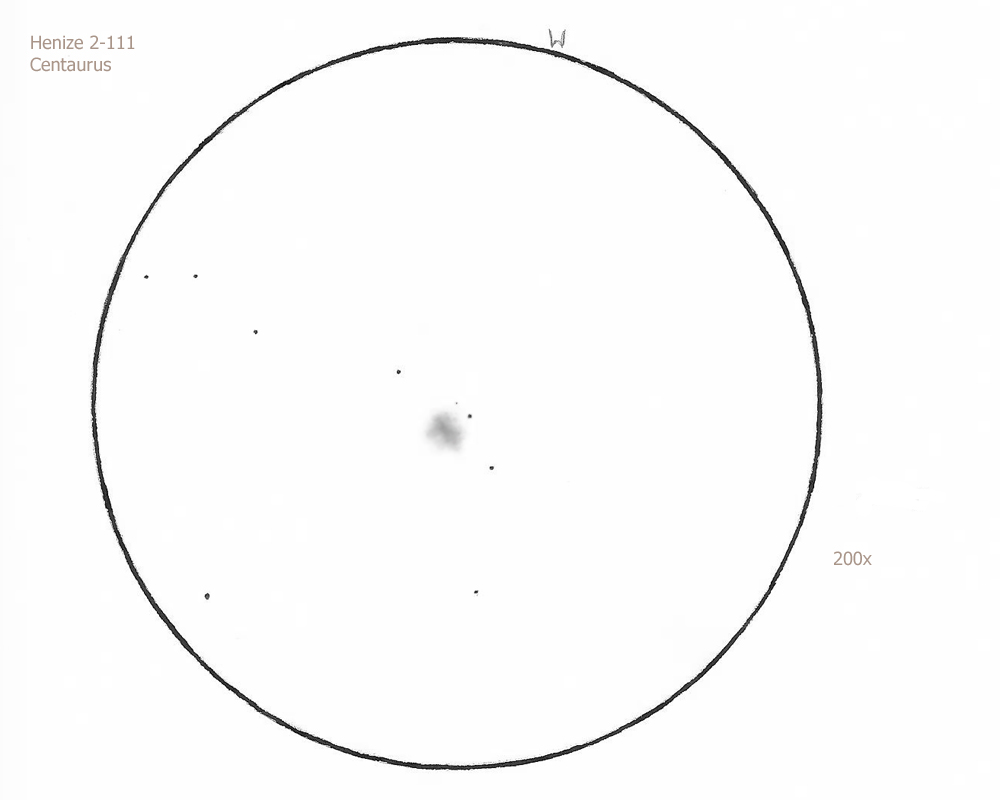
Here are some more sketches from that 1997 trip Down Under. These are some of the more obscure planetary nebulae I observed on that trip. All of these sketches were made at the 1997 Queensland Astrofest at Lions Camp Duckadang, Linville, Queensland on 25/26th and 26/27th August 1997. The scope I used was a 20 inch Dobsonian.
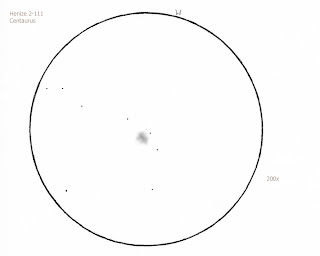 Henize 2-111, Centaurus
 Henize 2-141, Norma
 Henize 2-207, Ara
 Longmore 16, Scorpius
 Menzel 1 (PK 322-2.1), Norma
 Shapley 1 (PK 329+02.1), Norma
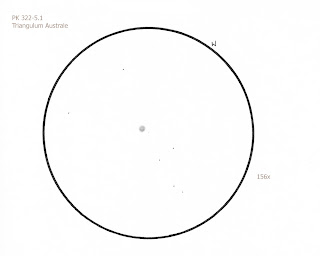 PK 322-5.1, Triangulum Australe
The observatory is still not up yet. That is because our weather has gone completely to pot and is now more like that of October than it is of mid-July. There are gale-force winds, low temperatures (17C/63F) and rain. Plenty of rain. This will please the miserable buggers who have moaned about the heat and lack of rain and who have now got their own way but I hate this crap and want summer back as soon as possible. Apart from anything else, there's no observing to be had but even before the weather completely broke up we'd been stuck in a cycle of clear afternoons and cloudy nights for a couple of weeks.
I might have to rethink getting a big scope. I have not yet been able to find a permanent full-time job and the agency work has completely dried up, although I have some part-time seasonal work delivering tourist guides. I have an interview in two weeks' time for a part-time data-entry job which offers just over £6000 ($9000) and if I get that, which won't be enough on its own, I could at least combine it with the seasonal work. Unfortunately this seasonal job only lasts for the duration of the holiday season before dropping back to a few hours a week.
A 16" Meade Lightbridge, at +/- £1800 is not beyond my financial reach on part-time/low wages but a custom-built scope at just over £3100 is, as things stand. Maybe I should just get a LB and then go for a custom-built David Lukehurst Dob when/if my work and financial situation improves? LB's aren't bad scopes with a bit of tweaking, although their mirror boxes are incredibly heavy for the size of the scope. Hopefully, though, by the time I have managed to put away £1.8K things might have improved.


The observatory is still not up yet. That is because our weather has gone completely to pot and is now more like that of October than it is of mid-July. There are gale-force winds, low temperatures (17C/63F) and rain. Plenty of rain. This will please the miserable buggers who have moaned about the heat and lack of rain and who have now got their own way but I hate this crap and want summer back as soon as possible. Apart from anything else, there's no observing to be had but even before the weather completely broke up we'd been stuck in a cycle of clear afternoons and cloudy nights for a couple of weeks.
I might have to rethink getting a big scope. I have not yet been able to find a permanent full-time job and the agency work has completely dried up, although I have some part-time seasonal work delivering tourist guides. I have an interview in two weeks' time for a part-time data-entry job which offers just over £6000 ($9000) and if I get that, which won't be enough on its own, I could at least combine it with the seasonal work. Unfortunately this seasonal job only lasts for the duration of the holiday season before dropping back to a few hours a week.
A 16" Meade Lightbridge, at +/- £1800 is not beyond my financial reach on part-time/low wages but a custom-built scope at just over £3100 is, as things stand. Maybe I should just get a LB and then go for a custom-built David Lukehurst Dob when/if my work and financial situation improves? LB's aren't bad scopes with a bit of tweaking, although their mirror boxes are incredibly heavy for the size of the scope. Hopefully, though, by the time I have managed to put away £1.8K things might have improved.
Monday, 14 June 2010
Where's summer gone?
It's mid June. We know this because it says so on the calendar, there are baby birds everywhere, there's too much daylight, the Isle of Wight Festival has just happened - and it is cloudy, wet and chilly. I have tried - and failed - to get out to see comet C/2009 R1 McNaught, every time I have planned to observe it, clouds have interfered. Hopefully, the weather will improve soon; the weather forecast is looking a bit better from tomorrow.
Friday, 14 May 2010
TSP Day 4 - Thunderheads and the Skunk Nebula
The evening didn't start out too promising as, during the late afternoon huge thunderheads built up, dominating the eastern and north-eastern sky. At one point, there was one huge and evil-looking cloud that looked unpleasantly like a mushroom cloud, prompting people to make jokes that someone had dropped a nuclear bomb nearby. The effect of late sunlight on the cloud enhanced its hideous appearance and people were pleased when it began to lose its shape. No thunderstorm materialised, although there was some lightning on the horizon.

The skies weren't too great for observing, although useable, and by three a.m. we decided to pack up for the night which was a shame because we were just on halfway through another of Larry's Lists, this time the 2000 list 'Rings Over Texas'. Last night's observing was a mix of the frustrating (clouds right where you want to look, bad seeing, not being able to find things) and the hilarious - a visitation from a skunk who was on the lookout for dropped food items. Unfortunately the little cutie came far too close for comfort and we spent ten minutes keeping an eye out for him and, at one point, abandoned Dennis' 18" and retreated to a safe distance while Mr. Skunk pottered around. He investigated people's tents and my bag (and I was thinking 'please don't spray it, please don't spray it!') before wandering off somewhere into the darkness. We had to use dim red torches and averted vision to keep track of the Skunk Nebula but, luckily, he didn't deploy his chemical warfare on us so the area around us and, more importantly, our possessions remained Eau de Skunk free.
Back to the observing and before being 'skunked' (ha ha) by the clouds and deteriorating sky we managed to observe about 14 of the objects on the list: NGC 2685, NGC 5122, NGC 2793, AM 1358-221, MCG-4-33-27, Arp 87, NGC 3681, Minkowski 1-64, 2H24, NGC 4650A, the central star in M57 and Mayall's Object.
I also whipped quickly through the TSP Binocular list and added to my pin collection.
Going to bed at three a.m. at least meant I was able to get up early enough to go birding this morning and I saw some nice species, especially Blue Grosbeaks. I went up to Indian Lodge State Park with Keith Taggart of El Paso, TX and I got some (hopefully good) photos of different species at feeding areas specially set up. Unfortunately Vermilion Flycatchers, a species I'd particularly like to see are still eluding me at present. I am told they're common but to me that seems they're common when I am not about. That's the story of my life when birding!

The skies weren't too great for observing, although useable, and by three a.m. we decided to pack up for the night which was a shame because we were just on halfway through another of Larry's Lists, this time the 2000 list 'Rings Over Texas'. Last night's observing was a mix of the frustrating (clouds right where you want to look, bad seeing, not being able to find things) and the hilarious - a visitation from a skunk who was on the lookout for dropped food items. Unfortunately the little cutie came far too close for comfort and we spent ten minutes keeping an eye out for him and, at one point, abandoned Dennis' 18" and retreated to a safe distance while Mr. Skunk pottered around. He investigated people's tents and my bag (and I was thinking 'please don't spray it, please don't spray it!') before wandering off somewhere into the darkness. We had to use dim red torches and averted vision to keep track of the Skunk Nebula but, luckily, he didn't deploy his chemical warfare on us so the area around us and, more importantly, our possessions remained Eau de Skunk free.
Back to the observing and before being 'skunked' (ha ha) by the clouds and deteriorating sky we managed to observe about 14 of the objects on the list: NGC 2685, NGC 5122, NGC 2793, AM 1358-221, MCG-4-33-27, Arp 87, NGC 3681, Minkowski 1-64, 2H24, NGC 4650A, the central star in M57 and Mayall's Object.
I also whipped quickly through the TSP Binocular list and added to my pin collection.
Going to bed at three a.m. at least meant I was able to get up early enough to go birding this morning and I saw some nice species, especially Blue Grosbeaks. I went up to Indian Lodge State Park with Keith Taggart of El Paso, TX and I got some (hopefully good) photos of different species at feeding areas specially set up. Unfortunately Vermilion Flycatchers, a species I'd particularly like to see are still eluding me at present. I am told they're common but to me that seems they're common when I am not about. That's the story of my life when birding!
Sunday, 9 May 2010
Epic trek
I arrived in San Antonio, TX, late on Friday night after delays caused by mechanical problems with the Continental Airlines Boeing 767-400 (a fault with the hydraulics on the braking system - very important on landing!) causing us to miss our take off slot from London Heathrow and then a big detour due to the volcanic ash, which meant the flight took 11 hours instead of the usual 8.5 and fighting 100mph headwinds over Canada and the northern US didn't help. Because of this I was four hours late into Houston, and missed my connection to San Antonio.
The detour was interesting as it took us up the centre of the UK and over the coast of northern Scotland (there's still snow in the Highlands), past the Faeroe Islands and north to just over the Arctic Circle. I could see Iceland - the cause of all the ash trouble - to the south and pack ice and icebergs in the Denmark Strait, between Iceland and Greenland. Other jets were in the sky, including one on a parallel course a few miles from us, on our port side, it looked highly impressive speeding along at 500mph with the contrail streaming behind - I expect we looked just as impressive to them.
Excuse the poor quality of the photos, airliner windows are not made of optical quality glass! The crap on the windows is ice crystals; according to the flight path map data, it was -64 outside.


Pack ice in the Denmark Strait
We flew over Greenland, and from the plane there were fantastic views of the coast just north of Angmagssalik; it was clear, displaying incredibly beautiful Arctic scenery with mountains, snow, huge cliffs and, at the coast, icebergs and pack ice. It looked lovely but I would not want to live there, too cold and it doesn't get dark at all in summer although I would love to visit.

Icebergs and pack ice on the Greenland coast


Greenland
We left Greenland behind just south of Godthab (Nuuk) and flew down over Canada (which seemed to take forever), the Great Lakes and into the United States. Our route over the US took us over Illinois, Missouri, Arkansas, the top left hand corner of Louisiana and into Texas before landing at George Bush Intercontinental in hot and humid Houston.
I'd missed my connection to San Antonio so, once I'd cleared US Immigration and Customs (the queueing took an hour, the actual process about three minutes) I had to go to Continental Airlines' check in desk, fully expecting to be told there were no more flights to San Antonio that evening and already forming my contingency plan (find a hotel and try to get Continental to pay for it! At least find a hotel) but, fortunately, that proved not to be the case. I got the last remaining seat on the last departure of the evening and made it to San Antonio just after 10 pm.
We're setting off for TSP tomorrow (Monday) and hoping the weather will be good. The forecast has already changed twice from good to bad to indifferent. Let's hope it changes back to good again. At the moment we're in for one totally clear night, four partially clear ones and a cloudy one with thunderstorms. I hope it improves! But, even if the weather's crap, it'll still be a fun event with great people and scenery. And it's a change of scene.
Monday, 3 May 2010
Bugger OFF!
More volcanic ash is heading our way from Iceland. At the moment it is predicted to cover Ireland and Scotland, with warnings of flight restrictions. I just hope it stays away from the rest of the UK, certainly until I am safely out of here on Friday. The winds aren't helping as they are unusually (because our winds usually come from the west but a high pressure system in the Atlantic is bringing in a northerly airflow) coming from the north and north west, although they are predicted to swing to the north east by Friday, which will hopefully help keep the stuff away.
Met Office London VAAC website latest ash prediction as of 1800Z
Met Office London VAAC website latest ash prediction as of 1800Z
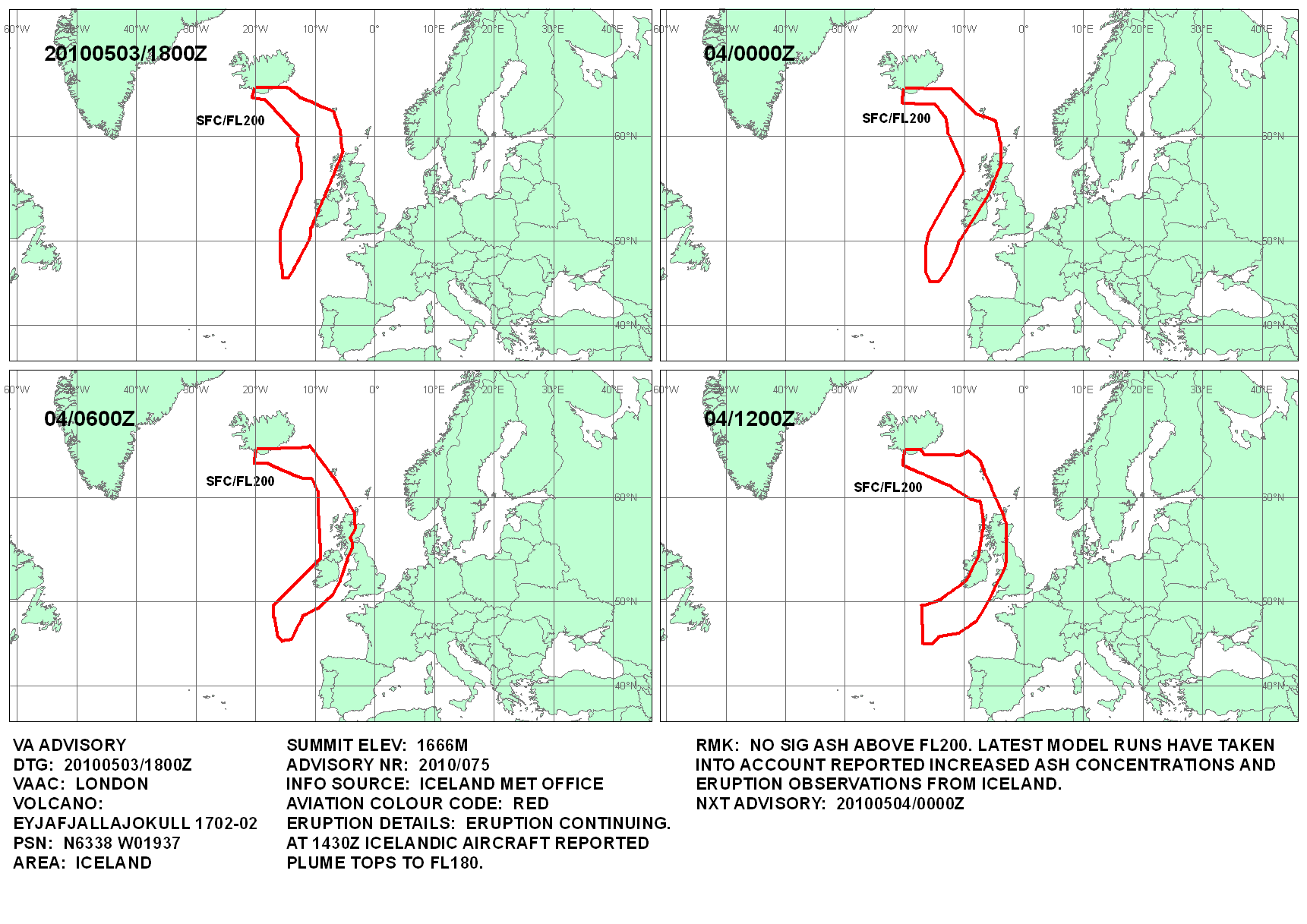
Sunday, 11 April 2010
Forecasters' idea of a 'clear sky' vs my idea of a clear sky!
Just recently, I have got more than a little annoyed and frustrated with the weather forecasters' less-than-accurate definition of "clear skies". To me, as to any other amateur astronomer, a clear sky DOES NOT mean murk, high cloud and other general crap obscuring the view of all but the brightest stars and planets. I am so fed up with reading on the forecasters' web sites (including the BBC) and hearing and seeing the weather bulletins on TV and radio promising "clear skies" only for it to be haze and murk with only a few bloated, bright stars and planets visible and all but the very brightest star clusters wiped out.
Okay, I understand that Joe and Jane Public don't give a toss about astronomy and that, as long as shadows are cast during the day and they see the odd star or two or the Moon (when around) at night then, to them, that constitutes "clear" but, can we have a bit more accuracy in the forecasting please? If it's going to be hazy, tell us. Don't fib and say it's going to be clear when there's actually going to be a load of high thin cloud around.
Yes, we do get contrails from jets passing overhead, but these dissapate quite quickly and the high thin rubbish is not all contrails in any case.
Yes, we do get contrails from jets passing overhead, but these dissapate quite quickly and the high thin rubbish is not all contrails in any case.
To this end, I have emailed the Mess Met Office. It most likely won't change anything but it's always good to let these sort of organisations know that people are taking notice of what they do and say and, if it's inaccurate, then they should know.
"I am an amateur astronomer and I am increasingly annoyed and frustrated, as are other amateurs, by the forecasters' definition of "clear skies". To us "clear skies" do not mean high haze and murk with only a few bright stars visible as this is NOT clear and is totally useless for doing any astronomy. Can we please have forecasts which more accurately reflect this and not misleading (from an astronomical point of view) ones that do not take into account high thin clouds? Several times recently clear skies have been forecast, only for those so-called "clear skies" to turn out to be murk and high cloud - and on checking the on-line forecast it still says "clear skies" when it obviously isn't!
I understand that the forecasts are aimed at the general public, a lot of whom consider a bit of hazy sunshine or a few bright, bloated stars and a murky Moon to be "clear" and who have no interest in, or understanding of, astronomy, but amateur astronomers are also members of the public and we'd like more accurate forecasts, please, taking into account haze and high thin clouds. "
I understand that the forecasts are aimed at the general public, a lot of whom consider a bit of hazy sunshine or a few bright, bloated stars and a murky Moon to be "clear" and who have no interest in, or understanding of, astronomy, but amateur astronomers are also members of the public and we'd like more accurate forecasts, please, taking into account haze and high thin clouds. "
Monday, 5 April 2010
Frustrating!
All this afternoon it has been looking good for a clear evening. Until just now when it clouded over - the satellite pic does not look good either, with the system out to the west turning round and dragging crap up from France. How annoying.

Above: Satellite image, from Sat24.com, showing the crud moving up from the south/south-west. There's a clear spot to the south west, but that, unfortunately, will miss us. The latest view shows it filling in, in any case.
Below: The view from the garden, looking south west, and an upstairs window, also looking south west, aren't any better.


It might clear off in the early hours but as I have to be at work tomorrow morning, that's not a lot of good. Hopefully, it'll be better later in the week. I have only managed five observing sessions since January, so this is all a bit depressing, especially as I want to get among the spring galaxies before the days lengthen so much that observing will become awkward. I think I'd like to emigrate to a clearer climate at a lower latitude. I'm glad winter's over but I hate the light nights.
Wednesday, 17 February 2010
Texas, here I come!
I booked my flight to Texas this morning. I could have booked online or phoned an airline but, wanting a change of scene, I headed to town and went to a travel agents. My flight is with United Airlines and I fly to San Antonio via Houston (and return the same way) on 7th May. It wasn't as expensive as I thought, only costing £457; last time I paid nearly £600 but that was because I'd left it very late to get a ticket.
Less than three months to go; I am looking forward to seeing everyone again!
-----------------------------------------------------------------------------------------------------------------
Mind you having just said all that...I am not above saying 'Hey that cloud looks like the starship Enterprise, or an elephant, or a bird, or the starship from Alien...' and so on. I may not like 'em much but clouds can be entertaining, for a few minutes, anyway.
Friday, 5 February 2010
Stuff...
I haven't gone away, I am still here. However, since getting off to a flying start 2010's observing has taken a nosedive, with endless crap weather and almost constant cloud cover. We did have three clear(ish) nights at the end of January, but these were - typically - around a Full Moon, so I didn't bother. I haven't even seen Mars this opposition.
Like other amateurs, I am hoping that the coming spring will bring clear skies and galaxies.
-----------------------------------------------------------------------------------------------------------------
In the meantime, we have the now annual Isle of Wight Star Party to look forward to in March, from Thursday 11th to Monday 15th March. I am a volunteer for this event, so I'll be there from the Friday night until the Sunday evening. Obviously, I hope we have good weather for this, not only for the - hopefully lengthy - observing sessions, but because I am camping and don't fancy it if the weather's unpleasant.
Subscribe to:
Posts (Atom)