Pages

Showing posts with label Open Clusters. Show all posts

Sunday, 3 July 2011

Summer observing

As those of us stuck at high latitudes know (I'm at 50° North), the long twilights of summer aren't that conducive to deep sky observing. When it does get 'dark' it's only astronomical twilight as the sun is less than 18° below the horizon. But while it may not be good for the really faint fuzzies (and here, I admit that webcam users and imagers have an advantage over us eyeball-only types) it's still dark enough for the bright DSOs. Even Messiers you've seen countless times before are worth repeated looks and, as it is really the only observing you can get during summer at these latitudes, it's better than nothing.
The good news is that sunsets started to get earlier from July 1st and from the 16th true darkness returns, only for 36 minutes on the first night but the hours of darkness soon get longer. With a reasonable 30-day forecast ('reasonable' meaning average for this time of year - warm sunshine, some showers, average/slightly above average temperatures), I should hopefully get in more observing later this month, good news as I am hoping the new 18" will be finished in around 3-4 weeks' time.
I did a little observing last night, going after the supernova in M51, which is still on show, and a little open cluster-hunting in northern Cygnus. There are several on the Herschel II list and real little gits they are too. NGC 7031, NGC 7067 and NGC 7082 were on my list as well as the bright nebula NGC 6857. I also took a look at M57, the Ring Nebula in Lyra.


My notes are as sparse as the clusters themselves were!


Date: 2nd July 2011
Conditions: Cloudless, cool (12° C/53.6° F), some dew
Seeing I-II (later)
Transparency: II
NELM: Around 5.5-5.8 due to the astronomical twilight. Definitely less than 6.0. Milky Way visible all the way to Sagittarius but lacking contrast
Equipment: 12" f/5 Dobsonian; Televue Panoptic 22mm (69x), Televue Radian 8mm (190), Televue Radian 5mm (304x)

SN2011dh in M51 has got a little brighter recently. It was definitely easier to see than last time but that's probably as much to do with no Moon in the sky as it is to do with the brightness of the supernova - M51's spiral arms were certainly easier to see this time out. I didn't make a sketch this time.

NGC 7031, open cluster in Cygnus - Small and quite poor. Compressed. 69x, 190x
NGC 7067, open cluster in Cygnus - Faint, adj to 9th mag star. In rich surroundings. 69x
NGC 7082, open cluster in Cygnus - Scattered, large, cluster. In rich area. Not that great and looks more like a richer portion of Milky Way. 69x

I'll come back to these on a darker night, and the same goes for NGC 6857 which I looked for, a little over-optimistically, but didn't see. It was at this point, around midnight, that the observing was interrupted by the kids in a house the other side of the footpath putting an insecurity light on, which encroaches on our garden - although it's worse in winter because of the lack of leaves on the hedge and trees. They'd gone out into the garden do do some camping (I assume they were camping as I heard what sounded like a tent being put up and a tent zipper being opened and closed) and obviously wanted to see what they were doing. I wish they'd used torches though. I decided to pack up, an hour earlier than I'd intended, as the light was a nuisance - and I didn't want to disturb them with 'funny noises' from across the way (it's strange how loud switching eyepieces and moving around can be in the dark) and, more importantly, I didn't want them disturbing me!
At least, when I get the new scope, it will be easier to move to another location in the garden, as it will break down and have wheelbarrow handles on it. I'm intending to move my observing spot further down the garden, although the 'observashed' will remain where it is, although I can move around depending on where I am looking at the time.
I shoved the 12" back into the shed and closed the doors on it. This morning, when I went up there to put it away properly, I found I'd left the Telrad switched on. Fortunately, a Telrad reticle uses up hardly any power so the batteries were far from flat. It's not the first time I've left a Telrad on and I guess it won't be the last!

-----------------------------------------------------------------------------------------------------------

Collimation's one of those weird things that has a reputation for being awkward, annoying and downright difficult and it's viewed almost as being akin to witchcraft, with 'The Knowledge' being available to only a select few individuals. However, observers need to know how to collimate their scopes properly in order to get a decent image in the eyepiece and to achieve focus at high magnifications. There's no real risk of buggering it up as the mirrors, even if they end up miles out of alignment, can easily be put right again. My current scope, a 12", is a real git when it comes to going out of collimation and I have to fix it before each and every session. I am hoping my new 18" won't be as temperamental.
For me, cleaning the mirrors holds far more trepidation than merely aligning the things. That's where things can really go wrong...I've managed to scratch a mirror attempting to clean it in the past.

For those who can't quite 'get' collimation - and in the past I have been among those people - check out the brilliant video tutorial on the website Andy's Shot Glass, which explains visual and laser collimation, simply and perfectly. Click here to see it. I have no association with Andy or his website but it's the best and most simple explanation of the process I have ever seen. Just reading about the process doesn't make it immediately clear and it may take several re-reads in order to make sense of it; seeing it, though, makes it much clearer. There are loads of websites which offer help with collimation, and there are threads about it on Cloudy Nights, but nothing is as helpful as actually seeing something demonstrated such as in the video.
The way to do it (and the best way for a lone observer such as myself) is to use the sighting tube to centre and tilt the secondary mirror, then use a laser collimator to get the beam right into the centre of the primary. Then you go to the back of the scope and adjust the primary mirror itself, getting the beam in the centre of the laser's display window, meaning everything is centered nicely when you look in the sighting tube again and your collimation is spot on. It's not hard and takes a couple of minutes. Pure visual collimation without a laser is more awkward, as that requires two of you to perform the procedure, unless you have arms like Mr Tickle, which most people including me, don't!

Sunday, 29 May 2011

Mini observing session, 27th May 2011

After a stormy and unpromising day, Friday night cleared nicely. I was out all evening, not getting home until past 11pm although, given the light nights at this time of year, that's not really a problem. However, I didn't feel like getting the 12" out - and the weather forecast indicated that clouds were soon going to roll in, continuing May's unsettled note (May's weather quite often is rubbish but I hope this isn't the start of yet another lousy summer) so instead I brought out the little 70mm refractor, recently released from its dark prison in the depths of a cupboard. It's imprisonment wasn't intentional, it's just that I don't have a lot of use for such a small scope. Or I didn't think I had, until I decided I want a travel scope just in case I am able to go anywhere next year. Unfortunately air travel restrictions don't allow you to take anything much larger than a small refractor or Mak-Cass overseas. People better at woodwork and metalwork than I am have made collapsible 8" or larger dobs for airline travel, but that's beyond my limited practical capabilities.
Anyway, with the lack of anything else to write about on here, here's a short account (I won't say 'report' like a lot of people do on astronomy forums; I don't like the term when used for descriptions of observing sessions as I think it's too formal, making it sound compulsory and too much like work) of the Friday night mini-session with the Vixen.

Date: 27th May 2011
Conditions: Cloudless, no dew, chilly, breezy.
Seeing: II
Transparency: II
Equipment: 70mm (2.8") f/6 Vixen refractor with Televue 25mm (16.8x) and 11mm (38x) Plossl eyepieces. Lumicon 2" UHC filter.


The summer Milky Way was rising, and Cygnus was beginning to clear the nearby trees, so I aimed the little scope at the various star fields. The beauty of a small rich-field scope is that you don't need a finder to aim it. Because of the wide field views, it's easy to find what you're looking for just by sighting along the tube, something which is all but impossible with a larger, longer focal length instrument.
As well as looking round the rich Milky Way of Cygnus, I looked for individual objects, bright Messiers generally. M29, a coarse and poor open cluster in Cygnus, was easily seen at 16.8x. Despite its sparseness it was an attractive sight at 38x, standing out nicely from the Milky Way. It's seven brightest stars were all easily seen in the tiny scope.
In Lyra, M57 was easily seen at 16.8x as a non-stellar object in a rich area. Putting up the magnification to 38x showed an oval with a darker middle.
Turning to Hercules, M13 was easily seen in the scope, and was resolved, despite being at a neck-twisting angle. No surprise there, as it's a naked eye object on a good night. It wasn't quite naked eye the other night, though, as the sky wasn't quite dark enough for that. I didn't bother with M92, because of the awkwardness of the eyepiece angle - one of the areas where a reflector beats a refractor hands down.
M81 and M82 in Ursa Major provided a lovely view at 38x. M81 was oval, with a slight hint of spiral arms while M82 was a bit brighter and showed mottling.
Scorpius was rising so I decided to see what M4 looked like with the 70mm. Despite its low altitude, the view was surprisingly good and the cluster began to resolve at 38x. If it was higher, it wouldn't be bad at all with the tiny scope.
Meanwhile, Vulpecula had cleared the trees, so I looked for and easily found M27, the Dumbell Nebula, at 16.8x, as a round patch in a rich area. I was expecting to just see M27's 'apple core' shape but, somewhat surprisingly, at 38x, the fainter lobes showed up well.

Back to Cygnus and NGC 7000 and IC 5070/5067, the North America and Pelican Nebulae. NGC 7000 is a pretty easy naked eye object as a shining patch adjacent to Deneb, as by now, it was 0040 and dark enough to see fainter objects. The shape was easy to make out with the help of my Lumicon 2" UHC filter held to my eye, with the dark 'Gulf of Mexico' prominent. IC 5070/5067 was fainter and needed averted vision to see properly. It's a nice sight through my 8x42 binoculars though.

It was getting cold and it was nearly 1am, so I packed up - which was the work of less than a few seconds, another plus factor of a small scope. Unfortunately small scopes don't cut it when you want to view faint deep sky objects and, with a rich field scope such as the 70mm, you can't get enough magnification for detailed views of DSOs or the planets. However, for a 'grab and go' scope and a travel scope, it's ideal. One scope can't do it all; my 12" is way too large and cumbersome to be much use as a 'grab and go scope' (being a one-piece tube it barely fits in my car) and doesn't give wide field views. As noted Arizona observer Steve Coe once said, 'There's no such thing as an all-purpose telescope'.

The Texas Star Party begins today. Hopefully they'll have good clear skies. I wish I was there.

Friday, 25 March 2011

Thursday evening at the local astro society

The weather recently has been clear, but murky, and last night was no exception. I went to our local society's observatory last night (every Thursday is the open evening and we usually get a mix of members and sometimes interested members of the public) and we took out some scopes, including a 10" Orion Intelliscope.
Unfortunately the mist and murk were worse than the previous night and we only were able to look at the brightest Messiers. Galaxies, as expected, were worst hit and even normally good Messier galaxies were almost obliterated. We did look at M105, NGC 3384, M65 and M66 (NGC 3628, one of the Leo Triplet with M65 and 66, was utterly wiped out by the murk), M81, M82, open clusters M93 and M46 (not a bad view despite their low altitude in Puppis and the misty conditions), perennial faves M42 and M43, plus the attractive blue and yellow double star Iota Cancri and, later when it rose, Saturn, whose rings have opened up since I last saw it.

I have never used an Intelliscope before. The concept is similar to the Argo Navis system, a digital setting circle. You enter your wanted Messier or NGC number, the display shows some numbers, which are how far you need to push the scope in altitude and azimuth to get to where you are going, along with arrows showing which direction you need to push the scope. The numbers get lower the nearer you are and when you arrive at the location the display will read 0<>0 0<>0. The society's Intelliscope was a little off, with the objects being just out of the field of view, but not by much. It's a neat system and I'd like a similar thing for my scope, maybe an Argo Navis, one day.

Despite the crap conditions it was a nice evening and we also spent the time putting the world to rights as well as observing. It was disappointing though, that only a handful of us were outside, with most people choosing to sit inside the building and chat. It's an astronomy society, so it would be nice if everyone was outside but that seems to be the difference betwen UK and US amateurs. Over there, it seems to be a more vibrant and active scene.

Clocks go forward on Sunday morning. Yuck.

Thursday, 10 March 2011

Observing 9th March 2011

Date: 9th March 2011
Conditions: Chilly, no wind at first but increased later on. Waxing crescent Moon was a bit of a nuisance and interfered slightly. Some drifting cloud
Seeing I
Transparency III-IV
Equipment: 12" Dob, 22mm Televue Panoptic (69x), 15mm Televue Plossl (101x)


NGC 2129, open cluster in Gemini - Totally dominated by 2 8th mag stars; the rest are much fainter (11th mag) plus some much fainter ones. At 69x it's hazy but is resolved at 101x. Bright, not scattered, quite compact. 69x, 101x

NGC 2266, open cluster in Gemini - Triangular haze with three slightly brighter stars in a line along SE side. One bright star at tip. Compressed, quite rich and partly resolved using averted vision at 101x. 69x, 101x

NGC 2304, open cluster in Gemini - Scattering of stars in semi-circle. There are 4 or 5 brighter stars with more scattered around. Fairly bright. 69x, 101x.

NGC 2355, open cluster in Gemini - Faint at 69x. Irregular. 69x shows dozens of faint stars on a misty background. At 101x the misty background has a vague S-shape. 69x, 101x.

NGC 2395, open cluster in Gemini - Irregular group of fairly bright stars plus fainter ones. Not rich. About 15 bright stars plus a couple of dozen or so fainter ones. Elongated N-S. 69x, 101x.

NGC 2420, open cluster in Gemini - Moderately faint patch. Rich, concentrated, fairly large. At 69x it's mostly unresolved mist but at 101x there are 14 or so brighter stars scattered across a background of unresolved stars. 69x, 101x.

Packed up at 2100 because the sky was getting murkier. I have now finished the H400 in Gemini, these were what was left over from last year.

---------------------------------------------------------------------------------------------------------------

Space shuttle Discovery returned to Earth for the last time yesterday. The shuttle program is nearly at an end, with only an Endeavour mission and a possible Atlantis mission, both to the ISS, left. It's a shame that, when Atlantis lands for the final time (if her mission gets approved), the shuttles will never fly in space again, instead finding themselves as museum pieces.

Monday, 7 March 2011

Observing 7th March 2011

Finally! After five months of endless cloud and the odd clear spell being around a gibbous or full Moon, I have actually managed to do some observing! It's been a totally cloudless day, a rarity in itself over this winter (which has been the cloudiest winter for 50 years, as well as one of the coldest), and the clouds stayed away as it got dark so I opened the shed and pulled out the scope. Everything seemed fine, the collimation was not too far out and the shed and silica gel had done their job of keeping the scope protected during some fierce winter storms and snow and the mirrors mould-free.

Date: 7th March 2011
Conditions: Chilly, cloudless, slight breeze with one or two stronger gusts that banged shed doors, no dew, no frost. That horrible light mentioned in my previous post has now gone!
Seeing: I
Transparency: II-III
NELM: 5.8-6.0
Equipment: 12" dob with 22mm Televue Panoptic (69x), 15mm Televue Plossl (101x), UHC, OIII filters.


I decided to knock off the remaining Herschel 400s I had left to do in Orion, left over from last year. The one failure was NGC 1788, no matter how much I searched, I couldn't find this little bugger. I think it had got too low.

NGC 2169, open cluster in Orion - This is an interesting cluster which looks like the number 37, upside down. The '7' is the westernmost part of the cluster. It has three bright stars and four fainter ones which make up the number 7.
The '3' is slightly larger and brighter than the '7', it also has three bright stars plus one slightly fainter one and six much fainter ones. There is a clear gap between the two components with no stars between them.. Very attractive. 69x, 101x

The sketch of 2169, below is not recent. It's a sketch I did some years ago but I thought I'd add it in to give an idea of what it looks like.


NGC 2194, open cluster in Orion - Easy to find. Quite faint but rich. There are a few quite faint, but distinct, stars in front of many, many fainter ones. Partly resolved. Detached - stands out well despite faintness. 69x, 101x

NGC 2186, open cluster in Orion - Awkward to find, especially as it's not shown on my Sky Atlas 2000.0 so I had to come back to the house and print off a MegaStar chart with telrad circles on it. Not easy with one eye tightly shut to preserve its night vision! Located within a triangle of bright stars, which points east. Faint. Poor. Not concentrated. 69x.

Hunted for NGC 1788. Got annoyed with it and gave up as I just could *not* locate the thing, so I moved on.

NGC 1999, reflection nebula in Orion - This was easy to find, as it is located just south of the Orion's Sword complex. Small, round and bright. Fuzzy with brighter middle. UHC does not improve the view much if any while OIII is totally useless. 69x, 101x, UHC, OIII.

It was a short session, slightly under a couple of hours. I'd inevitably forgotten a few items, such as printing off MegaStar charts and other bits I had to return to the house for, but it was a good session and I'm pleased. It's nice to be back, although I'd not been idle because I'd done a lot of birding (my other interest) over the winter. The Moon's on the rise again so, after this coming weekend, it might be a while before my next session. And I managed to avoid trampling the daffodils too badly in my observing patch, there were casualties but only one or two.

This is the sort of weather we've had over the winter (observing shed is the grey one in the background). Cloud, cold and more snow than usual.


I never did get to the Isle of Wight Star Party this year. I intended to, but caught a bad cold so, deciding that I would not be thanked for sharing (as well as not feeling like standing around in the dark with it) I didn't go.

Monday, 11 October 2010

Observing 10th October 2010

After seemingly endless clouds, gales, rain and murk for the past few weeks, the sky finally cleared and I was able to get out and knock off some Herschels last night, 10th October.
I decided to stay entirely within the borders of Cassiopeia and the list was mostly open clusters, apart from one galaxy. I'd already done some of the H400 objects within the constellation but still had a lot more to do. I also looked at non-NGC clusters that were nearby.

Date: 10th October 2010
Conditions: Cloudless, cool (10C), no dew, a little mist
Seeing: I, excellent
Transparency: II-III
NELM: 6.2

Equipment: 12" f/5 Dob, 22mm Televue Panoptic (69x), 15mm Televue Plossl (101x), UHC filter

NGC 129, open cluster in Cassiopeia - Large and fairly rich. Triangular with dark area cutting through it. 69x

NGC 136, open cluster in Cassiopeia - A bit of a bugger to locate as it's faint. Round, nebulous background with a scattering of faint stars on top. Pretty boring. 69x

NGC 225, open cluster in Cassiopeia - A complete contrast to the previous cluster. Bright, large, irregular, loose cluster. 21 bright stars plus some fainter ones among the bright ones. 69x

NGC 381, open cluster in Cassiopeia - Faint, rich and round. Detached. A chain of stars goes north from the main body of the cluster. Nice. 69x

NGC 436, open cluster in Cassiopeia - In same field of view at 69x as NGC 457 (also on the H400 list, but I'd observed this at an earlier date) and they both make a lovely sight. 436 is a small knot of stars and is irregularly shaped. Fairly rich with half a dozen or so brighter stars and many more fainter ones resolved. 69x, 101x

NGC 559, open cluster in Cassiopeia - Quite rich but relatively faint. Compressed. Some brighter stars (around mag 12) superimposed on a hazy background. Nice. 69x

NGC 637, open cluster in Cassiopeia - Compact and fairly bright o.c. There are seven brighter stars, plus more in the background. Crescent shaped. There's a double star just to the east. 69x, 101x

NGC 185, galaxy in Cassiopeia - Elongated glow, NE-SW with some concentration towards the centre. Core's not stellar, more diffuse. Quite large. 69x, 101x

NGC 7789, open cluster in Cassiopeia - This one's an absolute beauty. It's very large and extremely rich in fairly faint stars. There are no bright stars anywhere in this cluster but it's now definitely one of my favourites. The cluster is round, and the stars are all of the same, or similar, magnitudes and there's a hazy background hinting at even more stars - there must be hundreds.
There are also dark areas, semi circular patterns and this makes the cluster look like a rose seen face on. 69x, 101x.

NGC 7790, open cluster in Cassiopeia - Small, compressed, quite faint, irregular open cluster. Extends east-west. 69x, 101x

NGC 7788, open cluster in Cassiopeia - Just north of 7790, this is a larger, looser, brighter, sparser cluster than 7790 is. Irregular. 69x, 101x

Frolov 1, open cluster in Cassiopeia - Not much to write home about! Very small and sparse. The stars are faint and scattered. 101x

Harvard 21, open cluster in Cassiopeia - A scattered faint group of 8 stars. Irregular. 69x, 101x

King 12, open cluster in Cassiopeia - A small, bright knot NW of H21. Two bright stars and a lot of fainter ones. Compressed, not rich. 69x, 101x

NGC 654, open cluster in Cassiopeia - Nice o.c. Not round but irregular. Compressed. Quite bright. Nice. 69x, 101x

NGC 1027, open cluster in Cassiopeia - Large, irregular, bright o.c. Rich. Identified by 7th magnitude star near the centre. Other stars and 5th and 6th magnitude plus many fainter ones. 69x

Melotte 15, o.c. with nebulosity in Cassiopeia - Large, irregular sparse cluster. The nebulosity is only visible with the UHC filter. 69x, UHC filter.

I packed up at 2215, after an excellent session.

Friday, 17 September 2010

Observing, early morning 17th September 2010

The was taken tonight, not last night, but is otherwise identical. Lovely pink sunset with the promise of things to come.
The forecast looked good but, unfortunately, a waxing gibbous Moon was in the way, not setting until 0020 BST (one of life's mysteries is this - why does a waning Moon seem to take forever getting out of the way, yet the waxing stage seems really quick, only slowing down as it approaches Full Moon?). Because of this I decided not to go outside until it was out of the way, although I can never take a nap in these situations!


Date: 17th September 2010; 0130-0300 BST (0030-0200 GMT/UT)
Conditions: Cool, totally cloudless, no wind, slightly dewy

Seeing: Ant II-III
Transparency: I (excellent) - II (very good) later (M33 visible with unaided eye)
NELM: 6.5+
Equipment: 12" f/5 Dob, 22mm Televue Panoptic (69x), 15mm Televue Plossl (101x), 11mm Televue Plossl (138x)


NGC 1857, open cluster in Auriga - Faint, fairly rich, irregular. 69x, 101x

NGC 1175, galaxy in Perseus - Faint, not quite round. Diffuse elongated core. 69x, 138x

NGC 1177, galaxy in Perseus - NE of 1175. Very faint indeed. Barely seen. Possibly elongated. 138x

NGC 1245, open cluster in Perseus - Very nice large irregular cluster. Faint, fairly rich. Many faint stars. 69x, 138x.

I packed up at 0300 BST after a less successful session than I hoped for; I couldn't seem to track down most of the Herschel IIs I went for, yet there was nothing wrong with the sky conditions, however I put that down to being tired. An example of tiredness-related cock-ups was when I made some soup and attempted to defrost some bread in the microwave - I ended up nuking it because I pressed the wrong button! Still, an observing session with four objects is better than no observing session at all and a lot better than my sorry effort the other evening (9th September 2010).

However, observing in the early a.m. is a nice way to spend the time, maybe better than evening sessions. There is no-one around at all and it is very quiet, although when I dropped an eyepiece on the shed floor - fortunately without damage - it sounded like an explosion! Likewise when I went back to the kitchen to make the soup, the kettle sounded as loud as a volcano.

Apart from the sound of the horses in the next field, the snoring of my darling dog in her basket, the rustle and squeaks of rats and mice in the hedge and the snuffling of a badger in the lane, there were no other noises. That’s how I like my observing sounds to be. No machines, no loud TVs from the neighbours across the way, no music, just animals and the other sounds of the night.

Monday, 13 September 2010

Observing 12/13th September 2010

'I got the poison, I got the remedy, I got the pulsating rhythmical remedy'

...so goes the lyric of Prodigy's song Poison, and fairly appropriate as they were coming down the valley loud and clear from the 'Bestival' last night - also appropriate as I found a Death Cap toadstool in the garden yesterday, which I promptly threw in the bin out of reach of the dogs (DCs are the most poisonous toadstools known). I like the Prodigy, but I don't like the light pollution from the festival that was wiping out the north western, and most of the western, sky or Rob da Bank's DJ set of bad music that went on to almost 4am this morning (1am's fine, but later than that is not. I bet they've pissed off the entire Arreton valley). At least that's over for another year.

The weather forecast called for it to clear at sunset, the BBC (Met Office) said it would be clear all night but the others (Accuweather, Metcheck and The Weather Outlook) disagreed, forecasting it to be partly clear, and, in the end, they were right and the BBC were wrong.

Would this clear? Btw, the tree is dead but the birds like it so it stays
Conditions: Cool, but not cold, some drifting clouds at first, becoming murkier later. Slight dew.
Seeing: Ant II, very good
Transparency: III to IV later (III. Clear, some haze visible. Milky Way still visible but not detailed; IV. Milky skies, moderately hazy but observing of brighter NGCs doable/drifting cloud).
Equipment: 12" f/5 dob, 22mm Televue Panoptic (69x), 15mm Televue Plossl (101x), 8mm Televue Radian (190x), OIII filter. MegaStar 5 chart printouts, Sky Atlas 2000.0, Pocket Sky Atlas and NSOG Vols I and II


NGC 6996, open cluster in Cygnus - Located within NGC 7000 (the North America Nebula). Spiral shaped cluster of 30+ fairly faint stars. Spiral is anti-clockwise. Fainter stars among the brighter ones. Chain loops off to north before turning west. Quite large. Moderately rich. Observation interfered with by drifting clouds. 69x.

NGC 6824, galaxy in Cygnus - People think of Cygnus as a realm of open clusters, PNes and nebulae, but galaxies lurk here too. Fairly bright and easy to find as it stands out against the background sky. Almost round. Brightens gradually towards the core. Core diffuse, not bright. 69x, 190x.

NGC 6894, planetary nebula in Cygnus - A bit of a sod to find, faint and quite small. Not helped by milky sky. At low power, there is a hint of something fuzzy and oval. An OIII filter brings it out as a filled-in oval. At high power, and with the OIII,  it has a darker middle and looks annular. 69x, 190x, OIII filter.

The latter observation was being affected by the fireworks from the festival, I could see the flashes in the eyepiece while looking at NGC 6894, which was hard enough to see as it was. So I abandoned Cygnus and moved over to Triangulum and Aries, which were just clearing next door's oak trees from my position.

NGC 772, galaxy in Aries - Round, quite faint (low), condenses to non-stellar, but obvious, core. 69x, 101x.

NGC 672, galaxy in Triangulum - Quite faint, elongated west-east. No brightening in centre. Faint halo around bar. IC 1727 nearby but very faint that I want another look at it on a better night. 69x, 101x, 190x.

NGC 925, galaxy in Triangulum - Elongated, faint. Evenly bright with halo. Some foreground stars. 69x, 190x

NGC 890, galaxy in Triangulum - Round, bright. Bright non-stellar core. 69x, 190x.

By now, just before 0100 BST (midnight GMT/UT), the sky was getting progressively worse, with a lot of murk scattering light about so I packed in. There were a few other objects I hunted for, among them NGC 1156 and NGC 1012, both in Aries, as well as NGC 6857 in Cygnus and the infamous NGC 6772 in Aquila but these were all wiped out by murk and will have to wait until a better night.

Saturday, 4 September 2010

Observing 3rd/4th September 2010

Another clear night, another observing session. That's four in a week! I missed a couple of nights over the course of the week as they were murky and foggy and therefore no good for deep sky observing. Last night started off a little murky but gradually improved as the night went on.

Date: 3rd/4th September 2010
Conditions: Cool but not that chilly, a bit murky at first but improving later. No Moon. Started off clear, clouding over later.
Seeing: A I, superb.
Transparency: III, improving to II later (until clouds came)
NELM: 6.1 to 6.5 later on
Instrument: 12" f/5 dobsonian, 22mm Televue Panoptic (69x), 15mm Televue Plossl (101x), 8mm Televue Radian (190x), 5mm Radian (304x), OIII filter

NGC 6804, galaxy in Aquila - Faint, slightly oval, stellar core. 69x, 190x

NGC 6772, planetary nebula in Aquila - I wasted more than 30 minutes looking for this (not plotted on atlases) and eventually gave up. Annoying. Will have another go at this with a MegaStar chart I've just printed out.

NGC 7448, galaxy in Pegasus - Bright, elongated NW-SE. Brightens gradually towards the centre. 69x, 190x

NGC 7814, galaxy in Pegasus - Bright and easy to find, located near Ï’ Peg. Elongated NW-SE. Brightens towards the core which is bright but not stellar. 69x, 190x

NGC 7217, galaxy in Pegasus - Bright, round, condenses to bright but non-stellar core. 69x, 190x

Pegasus is now complete as far as the H400 is concerned, as I'd already observed some objects in it last autumn.

NGC 7686, open cluster in Andromeda - Irregular. Dominated by two bright yellow-orange stars. Loose. Fainter stars in background and around the two bright ones. Not particularly rich. 69x.

NGC 884 and 869 - the Double Cluster in Perseus - These are lovely things in a wide field eyepiece. Both clusters fit neatly into the field of view of my 22mm Panoptic (69x). If each one was isolated it would be a pretty object in its own right but, both together make one of the finest DSOs in the Northern Hemisphere - in fact the DC is (are) the best open cluster(s) in the sky and I genuinely think that we outdo the Southern Hemisphere with this one.
NGC 869 is smaller and more compact that its neighbour, 884. There are 2 bright stars in the centre, plus a compact triangular pattern of stars in the centre. 69x
NGC 884 is larger and looser. No central group of stars, unlike 869; there's empty space at the centre. The stars of 884 are more concentrated to the western side. 69x.
All stars in both clusters are white.

NGC 650-1 (M76), planetary nebula in Perseus - Very bright indeed, looking like a miniature M27 (in fact, it is called 'Little Dumbell'). It has a bi-lobed appearance with an outer shell extending off to the south west and north east; the south western one is slightly brighter. The south eastern lobe is slightly brighter but smaller, than the north western one.  An OIII filter brings it out nicely. 69x, 101x, OIII filter.

NGC 1023, galaxy in Perseus - Bright, elongated east-west. Condenses to very bright core. 69x, 101x

By this time, it was beginning to get very cloudy, so much so they were interfering with observing. In fact it took me several attempts to see NGC 1023 as cloud kept drifting across the field of view.
I finished the session with a look at Jupiter, which was shining incredibly brightly, like a searchlight, high in the south east. While I am not a planet observer, preferring deep sky, I was glad I had decided to look at the giant planet because the seeing was so good, in fact it was perfect, that I had incredible views and could put the magnification up to 304x without too much degradation of the image.
The North Equatorial Belt was detailed, while the STB was a bit fainter and there were festoons in some of the other bands on the planet; the North Temperate Belt showed a lot of detail, as did both polar regions. The zones also showed some marbling. The SEB, of course, is still missing or very faint.

Thursday, 2 September 2010

Observing 1st September 2010

The long-term forecast is not looking too clever for the autumn (if it was the Mess Met Office I would not believe it, but it's The Weather Outlook, who got this year's dismal summer spot on) so I'm going to fit in as much observing as I can until the weather breaks up.
I am also doing the Herschel II at the same time as the H400 and, looking at the list of them, I have already seen quite a few. Inevitable really, as I've been doing deep sky observing since 1993. However, my observing sessions always previously took the form of ambling round whichever constellation caught my eye at the time and I never really did a structured observing program in the past, so my observations are scattered around various note books and sketch pads, so I need to hunt them out and see what I have and haven't seen. Still, re-observing things is not going to be a chore - although quite a few Herschel II objects not being plotted on Sky Atlas 2000.0 is a nuisance.

Date: 1st September 2010
Conditions: Slightly chilly, no wind. Quite a lot of dew.
Transparency: III but better at zenith (II). Mostly clear except from some high cloud. Jupiter bloated with halo, however, the sky was good at zenith.
Seeing: I, very steady
NELM: 6.1 (a little skyglow reflecting from high clouds)
Instrument: 12" f/5 dobsonian with 22mm Televue Panoptic (69x), 15mm Televue Plossl (101x), 11mm Televue Plossl (138x), 8mm Televue Radian (190x), UHC and OIII filters.


NGC 6800, open cluster in Vulpecula - Large, loose irregular group of stars forming a distorted loop. Moderately faint. 15 brighter stars plus a load of fainter stars. Not rich. 69x.

NGC 6723, open cluster in Vulpecula - Not plotted on my Pocket Sky Atlas or Sky Atlas 2000.0, so I used the Night Sky Observers' Guide Vol 2 to find its position and plotted it myself on both atlases. I really need to start using my Uranometrias more - in fact I am planning to buy the second edition for use while observing and keeping the old ones on the book shelves.
It's easy to find 6723 once you know where it is. It's in a rich field, more or less halfway between α Vulpeculae and Cr 399. Faint and small. Not rich. Triangle of stars (10th/11th magnitude) at the centre help identify the cluster. 69x, 101x

At this point a neighbour across the way put his garden light on, so his dog could see while it was going about its 'evening constitutional'. I'd not seen this light before, or not noticed it (the reason being, our garden's very large and what happens the other end of it is not always noticed from the house or patio; the patio was my previous observing place), but it was badly aligned and blitzed my observing area. I think I'll be asking him if he can adjust it in future, if it's trespassing then it's aligned incorrectly.. After 15 minutes, I was wondering just how long it takes for a dog to have a pee (our dogs are in and out in two minutes!) when the light, thankfully, went off. These are the same neighbours who don't have curtains on their upstairs windows, no doubt believing themselves unseen (uh uh, no you're not!). If ever I win the lottery, I'm moving somewhere where I don't have neighbours! Why are the general public so obsessed with lighting everywhere up?


Ok, now the irritating light's been turned off, back to the observing and it's time for some faint nebulae.


Sh 2-101, nebula in Cygnus - near a double star, this is an area of faint nebulosity. I can't see it very well without a filter, but the UHC brings it out nicely. It's a large irregular patch with dark lanes in it. 69x, UHC

NGC 6888, emission nebula in Cygnus - Located among a conspicuous group of five stars, this can be seen without a filter, but only just. A UHC filter brings out the crescent shape nicely but an OIII isn't much of an improvement. With each filter there are hints of more extensive nebulosity to the north east of the crescent. the SW portion of the nebula is the brightest and the SE portion of the crescent is a bit fainter. 69x, UHC, OIII

Minkowski 92 (M1-92), (planetary?) nebula in Cygnus - This looks like a faint double star at low power but is obviously non-stellar at higher power. One 'star' is larger and brighter than the other and they are very close together. 69x, 101x, 138x, 190x.

I packed up at midnight, as the high clouds were moving in and it was getting mistier.

Tuesday, 31 August 2010

Observing 30th August 2010

Only a short session this one, due in part to a bad shoulder. Again, because of the Moon, I stuck to open clusters and went to do an H400 clean up run round Vulpecula.

Conditions: Clear, chilly, waning gibbous moon (around 65% full)
Seeing: Excellent, A1
Transparency: II-III

NELM: Not checked.
Instrument: 12" f/5 Dobsonian, 35mm Televue Panoptic (43x), 22mm Televue Panoptic (69x), 15mm Televue Plossl (101x), UHC filter.


NGC 6882 and 6885, open clusters in Vulpecula - Two for the price of one, in same field of view. Large, irregular pattern of stars with a conspicuous bright white one (20 Vulpeculae) off towards the edge. This is supposed to be two clusters but it's not easy to distinguish one from another. 69x, 101x

NGC 6830, open cluster in Vulpecula - Easy to find as it's fairly near M27. Irregular, compressed group of 20+ stars with many more, fainter, ones in the background. 69x, 101x

NGC 6823, open cluster with nebulosity in Vulpecula - Small, compressed cluster with three stars in a tight diagonal line in centre. Many more fainter stars in cluster. fairly rich.
No nebulosity seen without a filter, but with the UHC filter I can just see some faint nebulosity. One for when the moon's gone. 69x, 101x, UHC filter.

NGC 6802, open cluster in Vulpecula - Easy to find, located immediately next to Cr399. Quite large, fairly rich but needs moderate power to resolve. Looks misty at 69x, but stars begin to appear at 101x. Irregular, elongated north-south. Faint. 69x, 101x.

That finishes off the H400s in Vulpecula - I'd already seen NGC 6940 a while back. It also takes me past the magical 100-object mark, meaning I am just over a quarter of the way through the H400, as I am on 103 objects as I found out last night after a quick count of the ticks on my list.

Harvard 20, open cluster in Sagitta - A scattered group of 20 to 30 stars just SW of M71. Not much to write home about. 43x.

Packed up at 2330 BST as the moon was rising higher and its light was being scattered around the sky more than the previous evening, despite the phase being less.

Monday, 30 August 2010

Clusters by moonlight

It was the first clear night for a while so I decided to drag the scope out and do some observing, despite the waning gibbous moon. Because of the Moon, I thought that sticking to open clusters in the Herschel 400 was a good plan.
There was definitely an autumnal nip, as well as a 'smell' of autumn in the air. I put an extra layer on although, by the end of the session I was wanting to take it off as I was too warm.

Date: 29th - 30th August 2010
Conditions: Clear, slightly chilly, slight breeze
Seeing: Ant II - quite good, looked at Moon after session and there was not too much turbulence
Transparency: III - not too bad. Milky way washed out by rising moon
NELM: I didn't check, although it would have got a right hammering from the moon and would be no better than 5.5 or 5.8.
Instrument: 12" f/5 dobsonian with 22mm Televue Panoptic and 15mm Televue Plossl (69x and 101x)
2230 BST - 0015 BST (2130 UT - 2315 UT)


NGC 7044, open cluster in Cygnus - An absolute bugger to find. Small, compressed, not rich, faint. 69x, 101x

NGC 7062, open cluster in Cygnus - Much easier to find than 7044. Nice. rich, moderately faint cluster bordered by four brighter stars. Detached. Small. Stands out nicely. 69x, 101x

NGC 7086, open cluster in Cygnus - Compact, moderately faint. Rich. Detached. Set in a nice area. There are nine foreground stars with many more, resolved, fainter ones in background. Moon beginning to interfere. 69x, 101x

NGC 7128, open cluster in Cygnus - Very small, compact, compressed. There's a ring of brighter stars on a hazy background. There is a conspicuous reddish star on the SE side, which is the brightest star in the cluster. Very nice. 69x, 101x

That finishes the H400 objects in Cygnus, so I moved on to Cepheus. The Moon was getting higher and about to clear the oak trees that border the north side of the garden, so it was beginning to interfere with finding things.

NGC 6939, open cluster in Cepheus - Compressed, rich. Bordered to east by distinctive pattern of three stars. Quite bright. Nice cluster. 69x, 101x.

NGC 6949, galaxy in Cepheus - The charts showed this was in the same low power field of view as NGC 6939, so I decided to give it a go despite the moonlight washing out the sky. At 69x, 'something' was possibly there, at 101x there was a definite faint elongated smudge. I'll have another look at this when the moon's out of the way. 69x, 101x

NGC 7160, open cluster in Cepheus - Easily found bright knot of stars, dominated by two bright white stars like eyes, plus 5 fainter ones. Many other fainter stars in background. 69x, 101x

By this time it was past midnight and, although I didn't particularly want to go in, I packed up as the moon had cleared the tall trees which border the garden on the northern side and was becoming a real nuisance. I did have a quick look at the thing and it was quite spectacular, if horribly bright in the 12" (felt a headache coming on, how do people observe this thing?? Too bright for me!) before wheeling the scope back inside and putting everything away.

I doubt if I'll be observing tonight as, following closely on from my ankle injury, I've torn the rotator cuff in my left shoulder. Talk about accident prone!

Tuesday, 10 August 2010

Observing 7th-8th August 2010

The night of Saturday 7th August into Sunday was clear, although not as good as the previous Wednesday, so I pulled the scope out for a session looking for some summer Herschel 400 objects.

Conditions:
Clear, fairly warm, around 15C
NELM 6.0
Fairly humid with quite a lot of dew
Seeing II

Transparency II
Equipment: 12" f5 Dob, 35mm Televue Panoptic (43x), 22mm Televue Panoptic (69x), 15mm Televue Plossl (101x), 11mm Televue Plossl (138x), OIII, UHC

NGC 6834, open cluster in Cygnus - irregular, attractive cluster made up of a line of 5 brighter stars crossing an elongated haze. At 138x, most of the haze resolves into faint stars.
There's a separate clump to the immediate south of the main cluster, a knot of 10, or so, stars and another to the north, which has six stars.

NGC 6866, open cluster in Cygnus - Large, irregular cluster. Two chains of stars extend out from centre, one to the west and the other to the right. the western one is short and contains 7 brighter stars plus fainter ones. The eastern chain is longer and contains > 15 stars in a looping pattern.
There is a wide pair to the south.

Went after NGC 7044, but this was in the 'dob hole' and awkward to get at. One for another night, further into autumn when Cygnus is more to the west and that part's easier to get at.

NGC 7027, planetary nebula in Cygnus - not on the H400 list but I was in the area. I am not sure why I found this easily and not 7044, but then a PNe's easier to recognise than one of the myriad of open clusters and knots in the Milky Way in the Cygnus area.
7027 could easily be overlooked as just another star, as it is star like. However it isn't stellar as at 69x it looks slightly fuzzy and an OIII filter makes it really jump out as a PNe.
At 138x its oval with no obvious darkening in the centre.

NGC 7296, open cluster in Lacerta - quite small, but conspicuous cluster near Beta Lacertae. Some stars resolved at 69, more resolved at 101x.

NGC 7243, open cluster in Lacerta - large, irregular cluster which fills the field of view of the 22mm Panoptic (69x). There are at least 23 brighter stars and many more fainter ones. Nice.

NGC 7209, open cluster in Lacerta - large and quite bright. Around 40 to 50 stars resolved. A very vague, rounded 'm' shape.

I finished up with a trip into the North America and Pelican nebulae, using my 35mm Panoptic and 2" UHC filter. This was lovely, with wisps and and tendrils of subtle nebulosity everywhere. Here and there, hard edges were defined. Very nice indeed.

The next morning I found that, as the air heated up in the morning sunshine (Sunday was a hot day) my mirror had condensation on it. This is not good as repeated dewings up will cause the coating to deteriorate and fail and I don't want to have to pay out for a recoating before I get my 20". I opened up the scope and left it to dry out in the shed, with the shed doors open.
I posted on Cloudy Nights, asking how I can prevent this and most responses involved rigging up some kind of heating system. I am going to have to pay out for a car battery, an inverter and a lamp in the first instance and then, when I can afford it, a solar panel, at least 70w. However, a cheaper solution might be a large power pack with built-in inverter. That should run a low-watt lamp for a few hours to keep the mirror dry while the outside temps rise, although I am not sure exactly how long the charge would last, although some of these machines are pretty heavy-duty things. In the meantime, I have packed a couple of socks with silica gel and hung them inside the tube near, but not on, the mirror, then sealed the scope at both ends. I also went to Sainsbury's and bought a bag of silica gel (not clay) cat litter which I'll decant into socks and then hang inside the scope, tomorrow. Considering that quite a few of my socks have conspired to vanish, leaving only odd ones, they can do something useful! I blame the black hole that must be lurking somewere in the washing machine. The silica gel cat litter idea was also suggested on CN, stuffed socks and beanbags are the preferred method of holding them although, apparently someone once used a stuffed animal. WTF??!!

Thursday, 5 August 2010

Observing 4th August 2010

A day of intermittent heavy rain and thunder gave way to clear skies during the evening, for once exactly as the forecast had predicted. The BBC and Metcheck's forecasts both agreed, which seems to be a rare event in itself, so as it got dark I went and unlocked the observatory (I like the sound of that!) and pulled the scope out.
Earlier in the evening I had been in a pretty awful mood, no reason just a bad day, and felt more like saying 'sod it' and going to bed but I am very glad I didn't as the sky turned out to be magnificent.
All too often when you step outside and look up, what looks promising at first often proves to be pretty average, even poor, but not last night. After getting dark adapted, I checked the naked eye limiting magnitude, using charts of Ursa Minor and Cygnus, and it was better than 6.5! We have pretty dark skies here, but better than 6.5 is fairly rare. Usually we get between 6.0 and 6.5 but last night was as good as 6.7! I would guess that the heavy rain and thunder had cleared the atmosphere of pollutants and dust. During my trips to the TSP, I've seen people using 'iridescence' in the Milky Way to gauge transparency - the more iridescent the MW, the more transparent the sky. The Milky Way was just like that here last night, iridescent, which we rarely see because of summer haze. Visible to the unaided eye were M13, M31 (later on when clear of the trees) and NGC 7000, the North America Nebula These were truly great summer observing conditions and well worth the long wait for.

Conditions: Clear, quite chilly
Seeing: Very good: Ant II

Transparency: Excellent - I, but a few odd bits of drifting cloud later on
NELM: 6.5-6.7, dropping slightly when the waning crescent Moon rose later on


First was Aquila and a hunt for the few Herschel 400 objects (three) that are here:

NGC 6781, planetary Nebula in Aquila - Set in nice starry field this is large and oval and quite bright. It's easily seen without a filter but my OIII brings it out nicely. With the OIII, the pn looks slightly rounder with some darkening in the centre, without the filter I can't see the darkening very well. Very nice object. 69x, 101x + OIII

NGC 6755, open cluster in Aquila - An attractive, small, compressed cluster set in a nice Milky Way field. Stars all white and evenly bright. Found at 69x as a misty knot, detached from MW star field.
101x shows a tiny, vaguely triangular clump of stars, with around a dozen or so on a hazy background and with a fainter patch next to it but at 138x, the cluster looks like a butterfly with the left wing richer than the right one. Very pretty! 69x, 101x, 138x

NGC 6756, open cluster in Aquila - Next to NGC 6755 in the field of view of the 22mm Panoptic (69x). It's half a dozen stars on a misty background. Not as rich or as compressed as its neighbour. Framed by a bight star at either end. 69x, 101x, 138x

I saw on my star charts that the globular cluster Palomar 11, also in Aquila, was nearby, and given the excellent conditions I decided to have a crack at seeing it. After quite a few false starts I eventually found it. It's in quite a rich area and nailing it down was a bit hard. It appears as a roundish brightening of the sky. Its low surface brightness and location in quite a rich part of the sky made finding it difficult but I caught it eventually. The observation of the night, I think. 69x, 101x, 138x, 190x

I also decided to see if I could see ICs 59 and 63 in Cassiopeia. Given the great night it would have been a shame not to go for the faint stuff.

IC 59, IC 63, diffuse nebulae in Cassiopeia - These faint little buggers are right next to Gamma Cas, so it's necessary to put that out of the field of view before attempting to look for them. IC 59 is a faint fan-shaped patch while IC 63 is fainter still - in fact I barely saw 63, just a mere brightening in the area. 69x + UHC filter.

M31, galaxy in Andromeda - this lovely piece of eye candy is one of my favourites to look at and I always drop in to say 'hi' when I am observing and M31 is high enough. Last night's conditions gave me the best telescopic view I have ever had of this galaxy. Under average skies usually only the bright central area is visible but last night, I could see (using my big 35mm Panoptic, at 43x) the galactic disk spreading out across and beyond the field of view, and the dust lanes. It was spectacular, to say the least.

NGC 6229, globular cluster in Hercules - Very bright and easy to find (made a nice change from Pal 11 and the faint nebulae in Cassiopeia!). Small and round with a dense core at 69x.
At 138x, it began to look granular with some stars resolved, especially the outer ones.
At 190x, individual stars can be seen and the halo and core are very bright, still looked granular across the face. 69x, 138x, 190x.

NGC 6207, galaxy in Hercules - bright and easily seen at 69x. It is completely overshadowed by its big and bright famous neighbour, M13. Oval, with a brighter core. Elongated northeast-southwest. 69x, 101x
I also popped over to see the big showy eye candy neighbour, which was absolutely superb as usual and in the same field they make a nice pair, with the galaxy being a hidden treasure.

Before packing in, I dropped in on Jupiter, which was shining like a big searchlight in the eastern sky, as the seeing was so good, and it looked decidedly odd without the South Equatorial Belt, which has totally faded away.

By 0200, the waning crescent Moon was substantially interfering with the sky conditions and there was more drifting cloud around so that, along with the fact my feet were by now very cold (I was wearing thin trainers) made packing up a Very Good Idea. So did the prospect of work in a few hours. So within five minutes, I'd pulled the scope back into the shed, chucked my charts back in their box, gathered up my eyepieces, locked up and headed back to the house.
As mentioned in my previous post, I'd found that the addition of wheels made my scope eyepiece higher off the ground. I knew it would be higher but not *how* higher. Consequently, viewing stuff at the zenith required standing on tiptoes. This was awkward and uncomfortable, as it hurt my calf muscles and toes, so some sort of small stool was a must. I found a little plastic step stool in Tesco this afternoon, for £2.50, which will fit the bill nicely.

Thursday, 8 July 2010

From the notebooks - Australia 1997

I was going through old observing note books to scan in my sketches for my new website and I came across some from my observing trip to Australia in 1997. Those brought back some exciting and magical memories! I have decided to share some of the best ones here, as well as in their categories on my web site.
Click each image for a larger view.


NGC 5139, the great Omega Centauri. This 'King of the Globular Clusters' can be seen from southern Europe and the southern United States but has to be seen from the Southern Hemisphere in order to appreciate it in its full glory.
I looked at this wherever I went during both trips Downunder, from South America and also each time I have gone far enough south in the Northern Hemisphere to see it.
It's huge, slightly elliptical and has a curious footprint-shaped area of less star density or obscuring dust, just off-centre. Spectacular.

8" Cassegrain at 72x, Manly, Brisbane, Qld, Australia
August 11th, 1997


NGC 4755, the Jewel Box cluster in Crux.
This is my favourite star cluster, shaped like a capital 'A' and made up of blue and white stars of varying brightnesses but with a conspicuous red giant at the centre.

8" Celestron SCT, Alice Springs, NT, Australia
July 21st, 1997


NGC 6822, galaxy in Sagittarius. This is Barnard's Galaxy, a faint dwarf galaxy. The galaxy was a faint elliptical glow, quite faint against the background sky. Elongated 2:1 north-south with no central brightening.

20" Dobsonian at 60x. Lions Camp Duckadang, Linville, Qld, Australia
August 26th 1997


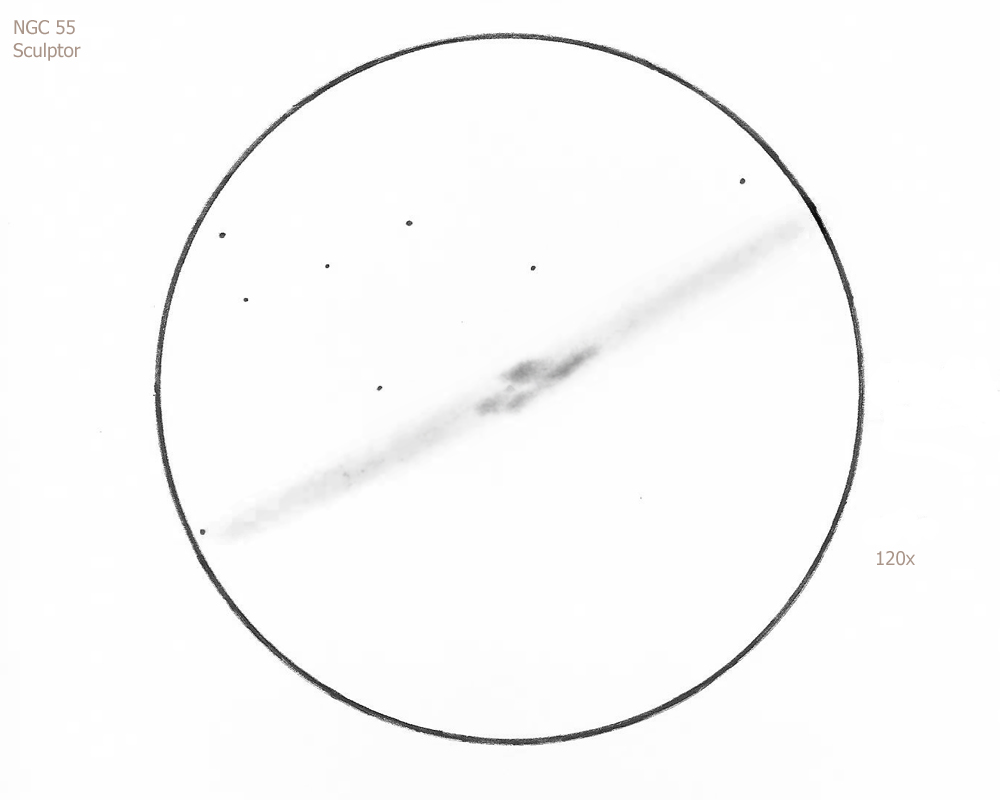
NGC 55, galaxy in Sculptor.
At -39 S, this is too low to be seen from England, even from the IW (our theoretical cut off is -40 but with atmospheric extinction, not a chance). Huge elongated galaxy with a very bright, mottled core. Only just fits into field of view at 120x.

12.5" Dall-Kirkham Cassegrain
Ellesmere, Qld, Australia
August 3rd 1997


NGC 7293, the Helix Nebula in Aquarius
I made two separate observations of this. One was from a rural site, the other from an urban one. Needless to say, I saw the nebula without an OIII filter more easily from the countryside than I did with a filter from the suburbs of Brisbane, where it was invisible. It was also 1st quarter Moon when I saw it in the suburbs.
Very large, oval ring with a low surface brightness and diffuse outer edges. No central star seen. Drawing made at the suburban site.
8" Cassegrain at 72x, Manly, Brisbane, Qld, Australia
August 11th, 1997

Sunday, 20 June 2010

Observing - in June!

I did some observing last night! Yes, observing in June! It can be done, provided you don't have to get up for work the following day because of the late hour, as you can't really begin before 0030 BST (2330 GMT/UT) due to the length of twilight at this time of year. The sky wasn't as dark as it normally is at other times of the year, with the Sun no more than 16 degrees below the horizon at 1am, and the Milky Way not as prominent as it is later in the summer and early autumn, but you can do something. I went out just before 1am BST with the 8x42 binoculars (I figured it wasn't worth taking out the 12 inch, just for a mere two or three hours), aiming to finish the AL Deep Sky Binocular Program; I had just four objects, all open clusters, left to find and these were in Cepheus and Lacerta with two in each constellation. These were NGC 7160 (Cep), NGC 7235 (Cep), NGC 7209 (Lac) and NGC 7243 (Lac).

Conditions: It was mostly clear, with some drifting cloud, although not enough to interfere with observing. It was also cold, the thermometer showing a dismal 7 degrees Celsius and the humidity was 72%.
Seeing: Very good, about II.
Transparency
: Not so good, a little drifting cloud and hazy, around III
NELM: Didn't check, although I'd guess it was no more than 5.8 at best.
Instrument: 8x42 binoculars.

NGC 7160, open cluster in Cepheus - Faint, round misty patch, no individual stars seen. 8x42 binoculars. 0055 BST

NGC 7235, open cluster in Cepheus - Easy to find small, misty patch. No stars resolved and averted vision does not improve the view. 8x42 binoculars. 0102 BST

NGC 7243, open cluster in Lacerta - Large, irregularly-shaped oc. Rich-looking. Granular when looked at directly, but with averted vision 10-15 individual stars appear. Hard to count them with handheld binocs. 8x42 binoculars. 0108 BST

NGC 7209, open cluster in Lacerta - Large and round. Rich. Granular with averted vision but with a few superimposed (foreground?) stars. Just a round misty patch when you look at it directly. 8x42 binoculars. 0115 BST.

That's the end of the AL Deep Sky Binocular Program for me. It's taken me, I think, a couple of years - looking at the notebook I have scribbled all this down in, I began doing this on 24th October 2008 so it's just a few days short of 20 months. Now I have to find another binocular program to do! There's the AL's Southern Sky Binocular Club but there's one major flaw with that one - I live at 50 degrees North so nearly all the stuff on there is immediately ruled out as inaccessible.
Using binoculars to do astronomy with is great, as binocular observing in its own right is fun and rewarding. It is also ideal for those occasions when conditions aren't quite good enough to justify setting up a telescope, for when you want to do some observing but can't be bothered to set up the telescope, for those occasional times when your scope has broken, or if you don't have a scope - these things happen to everyone at some time or another and binoculars (a.k.a. bins, nockies, binos or binocs) are ideal.

Tomorrow morning, at 1129 UTC (1229 BST), is the Summer Solstice (Northern Hemisphere), so after tomorrow the Sun will start to move back south from the Tropic of Cancer and the nights will gradually begin to draw in again, although we won't notice too much of a difference until mid-July. Sunrise will start to get later after 22nd June (the earliest sunrise is at 0442), but sunset (the latest time of which is 2122 local time) won't get any earlier until after the 28th.
Far be it from me to wish the time away but I can't wait to see the back of June as observing's difficult. I am looking forward to later on next month and into August when the summer's well underway, the summer goodies are still accessible and it starts to get dark enough to enjoy them properly. Let's hope the weather co-operates!

Thursday, 15 April 2010

Observing April 11th and 12th 2010

At last! A clear night - or was it? It certainly began promisingly enough with the skies clearing off so I set up just before sunset in the hope that I'd get some observing done.
Unfortunately this state of affairs didn't last long and after the session began drifting clouds appeared and, as if in a devious conspiracy, they sat right where I aimed my scope. It seemed that when I moved to a different part of the sky they followed!
However, despite this, I managed to see the grand total of three objects on my H400 list.

Conditions:
Chilly +4C
Seeing III, Trans IV - Drifting clouds interfereing with observing, plus some high cirrus stuff
NELM 6.0
Instrument: 12 inch f5 Dobsonian; 22mm Televue Panoptic (69x), 15mm Televue Plossl (101x), 8mm Televue Radian (190x), Lumicon OIII filter

NGC 2392 - planetary nebula in Gemini: Easy to find. At 69x it's round, fuzzy with bright middle. It's a greenish-blue colour. OIII brings it out well. At 190x it looks very fuzzy with a very bright centre and a dark area between outer parts and centre. 69x, 190x OIII

NGC 2420 - open cluster in Gemini: Nice, fairly small o.c. Very rich and moderately bright. Irregular shape with c. 30 bright stars on a nebulous background which is many many unresolved stars. The brighter stars are all the same, or similar, brightnesses. 69x, 101x

NGC 5194 and NGC 5195 - galaxies in Canes Venatici: Fantastic. NGC 5194 (aka M51) is a large, face-on spiral. Spiral structure is easily seen and it has a big, bright nucleus.
The companion, NGC 5195, is much smaller. Round with a halo surrounding a bright core. 69x, 101x.

At this point, the clouds were becoming more than just an irritation, they were becoming a damned nuisance, so I packed in. As I came back outside to pick up the scope base, the clouds had filled the sky.

-------------------------------------------------------------------------------------------------------------------------------------

The following night, 12th April, wasn't totally clear, so I didn't even bother carrying the scope out but, instead, decided to bag Melotte 111, the Coma Star Cluster, with my 8x42 binoculars. Mel 111 is on the AL Binocular Deep Sky list, which, apart from four objects in Cepheus and Lacerta, I have just about finished.
Easily seen with the naked eye, this huge open cluster is pretty spectacular in binoculars. It is harp-shaped, with 15 bright stars outlining the shape of the harp. There are many more fainter stars in among the brighter ones. The stars are all blue-white and the brightest ones all the same magnitude. Nice.

Saturday, 6 March 2010

Binocular quickie, 4th March 2010

Opportunities to get out and observe have been few and far between just recently, as much to do with not being able to get out as bad weather, and even on Thursday evening, which was beautifully clear, I only had an hour. So it was out with the 8x42s to knock some of the last eight or nine remaining items off my AL Deep Sky Binocular List.

Conditions: Clear, quite cold, around zero. No wind and no moon (not yet risen)
Naked eye visual magnitude: 6.1
Seeing. Ant II
Instrument: 8x42 Leica binoculars

The last few items on the list that were accessible this evening were open clusters and all, except NGC 2343 in Monoceros and NGC 2360 in Canis Major, were in Puppis, very low in the south. Here at 50 North our theoretical cut off is -40 South although, in practice, you're looking through more atmosphere so things are rendered fainter by haze and murk although, when it has been clear recently, the sky has been very clean, probably due to the biblical amounts of rain we had the week before last. I have been able to see deep into Puppis and even into Columba, the Dove - more on Columba a bit later.

I knocked five objects off the list:

NGC 2360, open cluster in Canis Major:
Fairly largish clump. Can see some stars with the good old averted vision. Elongated east to west.

NGC 2343, open cluster in Monoceros:
Small, round, clump of stars. None resolved. Quite bright.

NGC 2527, open cluster in Puppis:
This is where things get a little awkward, as this bugger is low down. Faintly seen as roundish patch.

NGC 2539, open cluster in Puppis:
Faint round patch south of M48. Looks granular when you look at it with averted vision.

NGC 2571, open cluster in Puppis:
Very crappily placed for us unfortunate northerners. Dim, roundish...you know when you're really struggling to say something about an object? This is one of those times.

Having bagged those five objects and with the rest not accessible, I decided, with the help of charts, to find out how far south I could actually see. My southern horizon is not too bad, despite a low hill in the way, but the constellations were placed well enough that the one I was after, Columba the Dove, was unobstructed - well the northernmost part is. I still had to get a garden chair to stand on, just to get slightly more elevation to peer over the hedge as this stuff is even lower than the clusters I was looking at in Puppis. I managed to see Sigma Columbae, plus one or two others in that constellation, and I'm hoping to do this again next week at the IW Star Party - weather permitting - as, with nothing but sea all the way from here to the Cherbourg Peninsula, I might be able to see a bit more.
It's nice to see Leo rising in the east, spring galaxies await!

Monday, 4 January 2010

Life - and observing - in the freezer

Or 'Christ, it's cold!' could be a subtitle. The UK, unusually, has been in the grip of subzero temperatures for a couple of weeks now, with daytime temperatures barely getting above zero and night-time ones plummeting down to minus ten or colder. A lot of the country has got snow - except us on the South Coast, fortunately (or is that 'unfortunately'? If you have to have precipitation of some form, at least let it be of the picturesque-but-not-a-chance-of-getting-to-work-today type), instead we have had sleet, freezing rain and black ice making lethal driving conditions...and a few clear nights. In fact, 2010 is off to a flying start and out of four nights I have had three observing sessions, two binocular and one telescopic.
Tonight was the telescopic night. The Moon, which is 77% of Full, wasn't to rise until 2131 GMT so when I arrived home from work, via a doctor's appointment, I set my scope up and left it to cool for an hour.

Conditions:
Very cold -6C, No wind, icy underfoot (frozen dog pee!)

No Moon (rose at 2131 GMT)
Seeing Ant III-IV, transparency II
NELM 6.2
Instrument: 12 inch (30 cm) f5 Dobsonian

I will update this post when I get home from work tomorrow, with the objects I observed, except for Abell 12 which I'll mention now. I reobserved it this evening and this time it DID pop out with the OIII filter, as described by numerous people. I know, such a doubting Thomas...
Other objects I did observe were NGC 1514, a planetary nebula in Taurus, NGC 1980, NGC 1981 and NGC 2024 (a poorer view than the one I had a couple of weeks ago - if the Flame's crap, don't even bother looking for the Horsehead). I also looked for Abell 4 in Perseus and didn't find it, although it is fairly near the bright open cluster M34, but I really need to download some charts with that in, as it wasn't on my Sky Atlas 2000.0 (didn't try Uranometria, though). Not a hefty return from an evening's observing, admittedly, but I wasn't out there that long, too bloody cold.

NGC 1514, planetary nebula in Taurus. This was a piece of cake to find. At low power, and at first glance it looks like a bright, if fuzzy, star - indeed this is the 9th magnitude central star - but with averted vision a halo of fuzz pops out at you. Popping in the OIII filter really brings it out. At a higher power (190x), I could see darker areas between the outer halo and the central star and there are brighter areas in the halo itself. Slightly elliptical. As well as the central star, there is a much fainter, smaller, star next to it probably a foreground star. 61x, 190x + OIII

NGC 1980, open cluster in Orion. North of M42 this is a nice open cluster which is richer than nearby NGC 1981. I counted around 31 stars of which 10 are fairly bright, All the stars are white. 38x

NGC 1981, open cluster in Orion. Beautiful but sparse. Dominated by very bright white star plus a slightly fainter double which is also white, plus 17 other, much fainter, stars. 61x

I couldn't track down Jonckheere 320 again, but as I was having problems with the icing up of my finders I will give that another go before the end of the winter. I have read reports of it being seen in a 10 inch under comparable sky so there's no reason I shouldn't see it.

It was 'one of those' sessions again - my OIII filter fell to bits, a retaining ring-type object dropped out of it and the thing just fell apart. Fortunately I screwed it back together again, only to drop it onto the concrete of the patio five minutes later with, luckily, no harm done. I also dropped eyepieces, charts and gloves, but that's because, despite gloves, my hands were a bit cold. I was definitely fortunate in that nothing actually broke; fell apart yes, but actually broke as in completely destroyed, no.

I packed up just after 9pm, and after bending over the eyepiece (my final objects of this short session were in southern Orion) I couldn't straighten up properly, a combination of lower back pain and stiffness due to cold and bad posture from being hunched over the eyepiece meant that I shuffled indoors to warm up looking like the Missing Link between humans and apes - that almost-knuckle-dragging stance of something that can't quite walk upright... Once the Missing Link phase had passed I carted everything back in, pleased I had done some observing, but not too pleased that I didn't do as much as I had intended.

I'll chuck in the descriptions tomorrow and maybe a drawing or two, if I get them tarted up and scanned in, which is a tad unlikely as I don't get in from work until nearly 6pm and if it is clear again I'll be observing.

Sunday, 3 January 2010

Binocular observing session 3rd January 2010

Another nice clear night, 2010 is off to a decent start, may it continue, but again I decided to use the binoculars for a short session instead of the scope.

Cold -3C, very hard frost already on ground adding to that left over from previous night
No wind
Moon not yet risen at start of session (87% full, rises at 2005GMT)
Seeing II-III, transparency II
NELM 6.0 to 6.3
Instrument: 8x42 binoculars (handheld)

Markarian 6, open cluster in Cassiopeia. Six or seven bright stars in a line, surrounded by fainter ones. 1910 GMT

Melotte 15, open cluster in Cassiopeia. Just to the north west of Mark. 6, this is smaller and fainter. Not resolved. Star in foreground. 1915 GMT

Stock 23 (Pazmino's Cluster), open cluster in Camelopardalis. Small clump of stars. At least three are visible with direct vision but hazy look hints at quite a few more. 1925 GMT

NGC 1342, open cluster in Perseus. Another look at this, without moon in the sky. Much better view. Large triangular patch with at least 4 stars resolved and many more unresolved. 1930 GMT.

NGC 253, galaxy in Sculptor. A large, faint, elongated glow south of Deneb Kaitos. The observation of the evening, given the low altitude and murk at that level. 1935 GMT.

NGC 1807, open cluster in Taurus. easy to find, at the top tip of Orion's bow. Oval, dominated by line of 4 bright stars plus fainter ones in background. 1945 GMT.

NGC 1817, open cluster in Taurus. Right next to 1807. Same size, but rounder and not as bright. No bright stars. 1947 GMT.

NGC 1907, open cluster in Auriga. Dominated by its bright neighbour the huge cluster M38, this is a small, round patch immediately next to, and south west of, M38. No stars resolved with direct vision but it looks speckly with averted vision. 1951 GMT.

At 1953 GMT there was a nice fireball which went through south Monoceros and burned out just south of Orion's feet. It was bright orange/yellow and broke up.

NGC 2232, open cluster in Monoceros. Large, sparse-looking cluster. One bright star and five or six others. Slightly interfered with by Moon, which is about to rise. 2000 GMT.

NGC 2244, open cluster in Monoceros. Large, bright open cluster elongated north-south, with nine or ten bright stars visible with direct vision and more with averted vision. Nebula not visible, due to rising Moon. 2005 GMT.

NGC 2251, open cluster in Monoceros. Small, fairly round knot of stars. Patch looks granular but I can't see any individuals in that lot. 2012 GMT.

NGC 2264, open cluster in Monoceros. Much larger than 2251, twice its size. Counted 11 stars, hard to do with the handheld binoculars. 2015 GMT.

NGC 2281, open cluster in Auriga. Elongated hazy patch. Line of four stars surrounded by haze (fainter ones). 2020 GMT.

NGC 2301, open cluster in Monoceros. Faint fuzzy patch. Not well seen as quite low and moonlight washing it out. 2025 GMT.

NGC 2343, open cluster in Monoceros. Not seen. Too low and too much crap in atmosphere to allow me to see it, not to mention the moonlight. Will have to do this one again another night when it's higher and there's no Moon.

NGC 2403, galaxy in Camelopardalis. Faint elongated glow. 2037 GMT.

Packed in at 2040 GMT. I now have only ten more objects left to do on the AL Deep Sky Binocular list. I should get this finished in the spring.