Pages

Showing posts with label Planetary Nebulae. Show all posts

Friday, 8 July 2011

Sweet Pea

Last year, while I was in Texas, I got a chance to observe with Jimi Lowrey, Alvin Huey and Jimi's huge 48" dob up at Limpia Crossing, near the ranch where TSP is held. While we were talking over dinner before heading up to Jimi's observatory, Jimi and Alvin told me about a discovery that Jimi had recently made while looking at the Sloan Digital Sky Survey images; Alvin had also been there at the time Jimi found it on the Sloan image. It was a small round green object in Draco and, due to its colour, Jimi nicknamed it the Sweet Pea. The Sweet Pea's status isn't certain at the moment although it's believed to be a planetary nebula. The strange thing about the Sweet Pea is that it is in the galactic halo and not the disk, meaning that it could be an object captured when the Milky Way galaxy consumed a neighbour that came too close. Most stars - and planetary nebulae - are in the disk of the galaxy.

Later that night, May 11 2010, when we were observing, Jimi asked me if I wanted to see the Sweet Pea and, naturally, I said 'yes'.

Sweet Pea, planetary nebula(?) in Draco - The Sweet Pea was round and fairly faint. I didn't sketch it, although I wished I had now! I initially saw it without a filter and it was tough, seen as a round brightening against the sky. It was definitely fuzzy, not stellar and a UHC filter helped a bit. 48" Dob @ 488x. Jimi and Alvin had already seen the Sweet Pea before, so that apparently made me the third person ever to visually see it. That's pretty amazing and what hard-core deep sky observing is about.

So, why didn't I mention the Sweet Pea when I wrote about the TSP way back last May? Well, Alvin and myself were sworn to secrecy as, understandably, Jimi did not want anyone else to nip in and steal the discovery for themselves, until the astronomers up at McDonald Observatory had studied it and confirmed it. It has now been confirmed, using the Hobby Eberly Telescope at McDonald Observatory (although the co-ordinates are not yet released), is now in the public domain and Jimi was awarded the Lone Stargazer Award for the discovery at this year's Texas Star Party.
I understand that the Sweet Pea was a major target for Larry's 36" and others at TSP this year, although I don't know if anyone saw it or not. It was tough with a 48" under dark and transparent Texas skies, it will probably be impossible with an 18" or 20" from the UK.

Jimi and professional astronomer Steve Odewahn from the HET feature in a program on Marfa Public Radio, talking about the Sweet Pea. Click here to listen. Go to Jimi's Page on Dark Skies Apparel for more about the Sweet Pea and some of Jimi's other observations.

I am hoping to catch up with Jimi and Alvin, as well as my other friends, at TSP 2012...

Monday, 13 September 2010

Observing 12/13th September 2010

'I got the poison, I got the remedy, I got the pulsating rhythmical remedy'

...so goes the lyric of Prodigy's song Poison, and fairly appropriate as they were coming down the valley loud and clear from the 'Bestival' last night - also appropriate as I found a Death Cap toadstool in the garden yesterday, which I promptly threw in the bin out of reach of the dogs (DCs are the most poisonous toadstools known). I like the Prodigy, but I don't like the light pollution from the festival that was wiping out the north western, and most of the western, sky or Rob da Bank's DJ set of bad music that went on to almost 4am this morning (1am's fine, but later than that is not. I bet they've pissed off the entire Arreton valley). At least that's over for another year.

The weather forecast called for it to clear at sunset, the BBC (Met Office) said it would be clear all night but the others (Accuweather, Metcheck and The Weather Outlook) disagreed, forecasting it to be partly clear, and, in the end, they were right and the BBC were wrong.

Would this clear? Btw, the tree is dead but the birds like it so it stays
Conditions: Cool, but not cold, some drifting clouds at first, becoming murkier later. Slight dew.
Seeing: Ant II, very good
Transparency: III to IV later (III. Clear, some haze visible. Milky Way still visible but not detailed; IV. Milky skies, moderately hazy but observing of brighter NGCs doable/drifting cloud).
Equipment: 12" f/5 dob, 22mm Televue Panoptic (69x), 15mm Televue Plossl (101x), 8mm Televue Radian (190x), OIII filter. MegaStar 5 chart printouts, Sky Atlas 2000.0, Pocket Sky Atlas and NSOG Vols I and II


NGC 6996, open cluster in Cygnus - Located within NGC 7000 (the North America Nebula). Spiral shaped cluster of 30+ fairly faint stars. Spiral is anti-clockwise. Fainter stars among the brighter ones. Chain loops off to north before turning west. Quite large. Moderately rich. Observation interfered with by drifting clouds. 69x.

NGC 6824, galaxy in Cygnus - People think of Cygnus as a realm of open clusters, PNes and nebulae, but galaxies lurk here too. Fairly bright and easy to find as it stands out against the background sky. Almost round. Brightens gradually towards the core. Core diffuse, not bright. 69x, 190x.

NGC 6894, planetary nebula in Cygnus - A bit of a sod to find, faint and quite small. Not helped by milky sky. At low power, there is a hint of something fuzzy and oval. An OIII filter brings it out as a filled-in oval. At high power, and with the OIII,  it has a darker middle and looks annular. 69x, 190x, OIII filter.

The latter observation was being affected by the fireworks from the festival, I could see the flashes in the eyepiece while looking at NGC 6894, which was hard enough to see as it was. So I abandoned Cygnus and moved over to Triangulum and Aries, which were just clearing next door's oak trees from my position.

NGC 772, galaxy in Aries - Round, quite faint (low), condenses to non-stellar, but obvious, core. 69x, 101x.

NGC 672, galaxy in Triangulum - Quite faint, elongated west-east. No brightening in centre. Faint halo around bar. IC 1727 nearby but very faint that I want another look at it on a better night. 69x, 101x, 190x.

NGC 925, galaxy in Triangulum - Elongated, faint. Evenly bright with halo. Some foreground stars. 69x, 190x

NGC 890, galaxy in Triangulum - Round, bright. Bright non-stellar core. 69x, 190x.

By now, just before 0100 BST (midnight GMT/UT), the sky was getting progressively worse, with a lot of murk scattering light about so I packed in. There were a few other objects I hunted for, among them NGC 1156 and NGC 1012, both in Aries, as well as NGC 6857 in Cygnus and the infamous NGC 6772 in Aquila but these were all wiped out by murk and will have to wait until a better night.

Friday, 10 September 2010

And the award for...

... 'Fewest Objects Observed in One Session' goes to me for last night's pathetic effort. The forecast wasn't promising although it was predicted to cloud over around midnight, which would have left me with best part of three hours observing time. Unfortunately things didn't work out as intended. Firstly, for some reason, my collimation was way out, probably as a result of wheeling the scope across a rough part of the lawn, so it took me a few minutes to sort that out and secondly, I wasted ages - again - looking for the planetary nebula NGC 6772 in Aquila which, for some reason, I failed to find.
By the time I'd given up on NGC 6772, clouds were moving in, earlier than the forecasters predicted so there was nothing for it other than to wheel the scope back in and shut up shop. The upshot of all this was that I observed precisely zero objects in one hour, with the sole exception of a glance at Jupiter while aligning my finders. And a creepy-crawly fell on me! I hate creepy-crawlies, especially spiders, of which there are a lot around this autumn. All, with the backdrop of sounds coming down the valley from the 2010 Bestival. A cry of "Rock and f*cking roll!!" was heard at one point! At least, I think that's what he said!

So, why have I failed, on two seperate occasions, to find NGC 6772? It's in the Herschel II list so it's not terribly easy but it shouldn't be that hard either and, as someone who has plenty of experience, I would *expect* to be able to find it! NGC 6772 is not marked on Sky Atlas 2000.0 so I printed off a chart from Megastar 5, complete with Telrad circles, and used that. Despite this, I came up empty-handed. The Night Sky Observer's Guide Vol II has descriptions of this from 8/10" scopes so why was I failing to find the little bugger with a 12" with decent, clean optics under dark skies?
I think the problem is that Aquila is getting low and its altitude isn't favourable by the time its dark enough for observing at this time of the year and, as 6772 has quite a low surface brightness any little bit of murk would wipe it out and the past two observing sessions haven't been the most transparent. I will have to wait until next year when Aquila is higher during darkness, or catch it during the early hours in spring.

---------------------------------------------------------------------------------------------

My mum and stepfather moved house from Wootton to Niton last week, so my aunt and me went over to help mum with the last of the packing and the cleaning (steppy had already cleared off!) and it was the end of an era in some ways. We - myself, mum, my sister and stepfather - moved in during November 1984 (I was 14 at the time) and, in the early 1990s, the garden was my first ever observing site where I'd set up my tiny birding scope, my 10x50 binoculars sellotaped(!) to a tripod and, then, my first proper astronomical telescope which was a 6 inch reflector made from a gas pipe, some plywood and a mirror set purchased from David Hinds.
I took my compact camera with me and grabbed a few shots in between packing up and washing floors and walls.


My first ever observing site, looking east. My scope would go where the veg patch is (it was all lawn then)
Looking south (the trees have grown a lot since then)
Many a happy hour was spent in here (the conservatory) planning observing sessions and reading Sky and Telescope, Webb Society journals and astronomy books!

When we drove off, following the removal truck to their new place in Niton, I had mixed feelings. While my teenage years living there weren't the best (an understatement as they absolutely sucked!), it was my first observing site and brought back memories of the excitement of my early years in astronomy. I also lived back there for a few months immediately prior to my 1997 observing trip to Australia and clearly remember the exciting times then when planning that trip. I love the memories of those times and it was nice to revisit them, albeit briefly.

Saturday, 4 September 2010

Observing 3rd/4th September 2010

Another clear night, another observing session. That's four in a week! I missed a couple of nights over the course of the week as they were murky and foggy and therefore no good for deep sky observing. Last night started off a little murky but gradually improved as the night went on.

Date: 3rd/4th September 2010
Conditions: Cool but not that chilly, a bit murky at first but improving later. No Moon. Started off clear, clouding over later.
Seeing: A I, superb.
Transparency: III, improving to II later (until clouds came)
NELM: 6.1 to 6.5 later on
Instrument: 12" f/5 dobsonian, 22mm Televue Panoptic (69x), 15mm Televue Plossl (101x), 8mm Televue Radian (190x), 5mm Radian (304x), OIII filter

NGC 6804, galaxy in Aquila - Faint, slightly oval, stellar core. 69x, 190x

NGC 6772, planetary nebula in Aquila - I wasted more than 30 minutes looking for this (not plotted on atlases) and eventually gave up. Annoying. Will have another go at this with a MegaStar chart I've just printed out.

NGC 7448, galaxy in Pegasus - Bright, elongated NW-SE. Brightens gradually towards the centre. 69x, 190x

NGC 7814, galaxy in Pegasus - Bright and easy to find, located near ϒ Peg. Elongated NW-SE. Brightens towards the core which is bright but not stellar. 69x, 190x

NGC 7217, galaxy in Pegasus - Bright, round, condenses to bright but non-stellar core. 69x, 190x

Pegasus is now complete as far as the H400 is concerned, as I'd already observed some objects in it last autumn.

NGC 7686, open cluster in Andromeda - Irregular. Dominated by two bright yellow-orange stars. Loose. Fainter stars in background and around the two bright ones. Not particularly rich. 69x.

NGC 884 and 869 - the Double Cluster in Perseus - These are lovely things in a wide field eyepiece. Both clusters fit neatly into the field of view of my 22mm Panoptic (69x). If each one was isolated it would be a pretty object in its own right but, both together make one of the finest DSOs in the Northern Hemisphere - in fact the DC is (are) the best open cluster(s) in the sky and I genuinely think that we outdo the Southern Hemisphere with this one.
NGC 869 is smaller and more compact that its neighbour, 884. There are 2 bright stars in the centre, plus a compact triangular pattern of stars in the centre. 69x
NGC 884 is larger and looser. No central group of stars, unlike 869; there's empty space at the centre. The stars of 884 are more concentrated to the western side. 69x.
All stars in both clusters are white.

NGC 650-1 (M76), planetary nebula in Perseus - Very bright indeed, looking like a miniature M27 (in fact, it is called 'Little Dumbell'). It has a bi-lobed appearance with an outer shell extending off to the south west and north east; the south western one is slightly brighter. The south eastern lobe is slightly brighter but smaller, than the north western one.  An OIII filter brings it out nicely. 69x, 101x, OIII filter.

NGC 1023, galaxy in Perseus - Bright, elongated east-west. Condenses to very bright core. 69x, 101x

By this time, it was beginning to get very cloudy, so much so they were interfering with observing. In fact it took me several attempts to see NGC 1023 as cloud kept drifting across the field of view.
I finished the session with a look at Jupiter, which was shining incredibly brightly, like a searchlight, high in the south east. While I am not a planet observer, preferring deep sky, I was glad I had decided to look at the giant planet because the seeing was so good, in fact it was perfect, that I had incredible views and could put the magnification up to 304x without too much degradation of the image.
The North Equatorial Belt was detailed, while the STB was a bit fainter and there were festoons in some of the other bands on the planet; the North Temperate Belt showed a lot of detail, as did both polar regions. The zones also showed some marbling. The SEB, of course, is still missing or very faint.

Tuesday, 10 August 2010

Observing 7th-8th August 2010

The night of Saturday 7th August into Sunday was clear, although not as good as the previous Wednesday, so I pulled the scope out for a session looking for some summer Herschel 400 objects.

Conditions:
Clear, fairly warm, around 15C
NELM 6.0
Fairly humid with quite a lot of dew
Seeing II

Transparency II
Equipment: 12" f5 Dob, 35mm Televue Panoptic (43x), 22mm Televue Panoptic (69x), 15mm Televue Plossl (101x), 11mm Televue Plossl (138x), OIII, UHC

NGC 6834, open cluster in Cygnus - irregular, attractive cluster made up of a line of 5 brighter stars crossing an elongated haze. At 138x, most of the haze resolves into faint stars.
There's a separate clump to the immediate south of the main cluster, a knot of 10, or so, stars and another to the north, which has six stars.

NGC 6866, open cluster in Cygnus - Large, irregular cluster. Two chains of stars extend out from centre, one to the west and the other to the right. the western one is short and contains 7 brighter stars plus fainter ones. The eastern chain is longer and contains > 15 stars in a looping pattern.
There is a wide pair to the south.

Went after NGC 7044, but this was in the 'dob hole' and awkward to get at. One for another night, further into autumn when Cygnus is more to the west and that part's easier to get at.

NGC 7027, planetary nebula in Cygnus - not on the H400 list but I was in the area. I am not sure why I found this easily and not 7044, but then a PNe's easier to recognise than one of the myriad of open clusters and knots in the Milky Way in the Cygnus area.
7027 could easily be overlooked as just another star, as it is star like. However it isn't stellar as at 69x it looks slightly fuzzy and an OIII filter makes it really jump out as a PNe.
At 138x its oval with no obvious darkening in the centre.

NGC 7296, open cluster in Lacerta - quite small, but conspicuous cluster near Beta Lacertae. Some stars resolved at 69, more resolved at 101x.

NGC 7243, open cluster in Lacerta - large, irregular cluster which fills the field of view of the 22mm Panoptic (69x). There are at least 23 brighter stars and many more fainter ones. Nice.

NGC 7209, open cluster in Lacerta - large and quite bright. Around 40 to 50 stars resolved. A very vague, rounded 'm' shape.

I finished up with a trip into the North America and Pelican nebulae, using my 35mm Panoptic and 2" UHC filter. This was lovely, with wisps and and tendrils of subtle nebulosity everywhere. Here and there, hard edges were defined. Very nice indeed.

The next morning I found that, as the air heated up in the morning sunshine (Sunday was a hot day) my mirror had condensation on it. This is not good as repeated dewings up will cause the coating to deteriorate and fail and I don't want to have to pay out for a recoating before I get my 20". I opened up the scope and left it to dry out in the shed, with the shed doors open.
I posted on Cloudy Nights, asking how I can prevent this and most responses involved rigging up some kind of heating system. I am going to have to pay out for a car battery, an inverter and a lamp in the first instance and then, when I can afford it, a solar panel, at least 70w. However, a cheaper solution might be a large power pack with built-in inverter. That should run a low-watt lamp for a few hours to keep the mirror dry while the outside temps rise, although I am not sure exactly how long the charge would last, although some of these machines are pretty heavy-duty things. In the meantime, I have packed a couple of socks with silica gel and hung them inside the tube near, but not on, the mirror, then sealed the scope at both ends. I also went to Sainsbury's and bought a bag of silica gel (not clay) cat litter which I'll decant into socks and then hang inside the scope, tomorrow. Considering that quite a few of my socks have conspired to vanish, leaving only odd ones, they can do something useful! I blame the black hole that must be lurking somewere in the washing machine. The silica gel cat litter idea was also suggested on CN, stuffed socks and beanbags are the preferred method of holding them although, apparently someone once used a stuffed animal. WTF??!!

Thursday, 5 August 2010

Observing 4th August 2010

A day of intermittent heavy rain and thunder gave way to clear skies during the evening, for once exactly as the forecast had predicted. The BBC and Metcheck's forecasts both agreed, which seems to be a rare event in itself, so as it got dark I went and unlocked the observatory (I like the sound of that!) and pulled the scope out.
Earlier in the evening I had been in a pretty awful mood, no reason just a bad day, and felt more like saying 'sod it' and going to bed but I am very glad I didn't as the sky turned out to be magnificent.
All too often when you step outside and look up, what looks promising at first often proves to be pretty average, even poor, but not last night. After getting dark adapted, I checked the naked eye limiting magnitude, using charts of Ursa Minor and Cygnus, and it was better than 6.5! We have pretty dark skies here, but better than 6.5 is fairly rare. Usually we get between 6.0 and 6.5 but last night was as good as 6.7! I would guess that the heavy rain and thunder had cleared the atmosphere of pollutants and dust. During my trips to the TSP, I've seen people using 'iridescence' in the Milky Way to gauge transparency - the more iridescent the MW, the more transparent the sky. The Milky Way was just like that here last night, iridescent, which we rarely see because of summer haze. Visible to the unaided eye were M13, M31 (later on when clear of the trees) and NGC 7000, the North America Nebula These were truly great summer observing conditions and well worth the long wait for.

Conditions: Clear, quite chilly
Seeing: Very good: Ant II

Transparency: Excellent - I, but a few odd bits of drifting cloud later on
NELM: 6.5-6.7, dropping slightly when the waning crescent Moon rose later on


First was Aquila and a hunt for the few Herschel 400 objects (three) that are here:

NGC 6781, planetary Nebula in Aquila - Set in nice starry field this is large and oval and quite bright. It's easily seen without a filter but my OIII brings it out nicely. With the OIII, the pn looks slightly rounder with some darkening in the centre, without the filter I can't see the darkening very well. Very nice object. 69x, 101x + OIII

NGC 6755, open cluster in Aquila - An attractive, small, compressed cluster set in a nice Milky Way field. Stars all white and evenly bright. Found at 69x as a misty knot, detached from MW star field.
101x shows a tiny, vaguely triangular clump of stars, with around a dozen or so on a hazy background and with a fainter patch next to it but at 138x, the cluster looks like a butterfly with the left wing richer than the right one. Very pretty! 69x, 101x, 138x

NGC 6756, open cluster in Aquila - Next to NGC 6755 in the field of view of the 22mm Panoptic (69x). It's half a dozen stars on a misty background. Not as rich or as compressed as its neighbour. Framed by a bight star at either end. 69x, 101x, 138x

I saw on my star charts that the globular cluster Palomar 11, also in Aquila, was nearby, and given the excellent conditions I decided to have a crack at seeing it. After quite a few false starts I eventually found it. It's in quite a rich area and nailing it down was a bit hard. It appears as a roundish brightening of the sky. Its low surface brightness and location in quite a rich part of the sky made finding it difficult but I caught it eventually. The observation of the night, I think. 69x, 101x, 138x, 190x

I also decided to see if I could see ICs 59 and 63 in Cassiopeia. Given the great night it would have been a shame not to go for the faint stuff.

IC 59, IC 63, diffuse nebulae in Cassiopeia - These faint little buggers are right next to Gamma Cas, so it's necessary to put that out of the field of view before attempting to look for them. IC 59 is a faint fan-shaped patch while IC 63 is fainter still - in fact I barely saw 63, just a mere brightening in the area. 69x + UHC filter.

M31, galaxy in Andromeda - this lovely piece of eye candy is one of my favourites to look at and I always drop in to say 'hi' when I am observing and M31 is high enough. Last night's conditions gave me the best telescopic view I have ever had of this galaxy. Under average skies usually only the bright central area is visible but last night, I could see (using my big 35mm Panoptic, at 43x) the galactic disk spreading out across and beyond the field of view, and the dust lanes. It was spectacular, to say the least.

NGC 6229, globular cluster in Hercules - Very bright and easy to find (made a nice change from Pal 11 and the faint nebulae in Cassiopeia!). Small and round with a dense core at 69x.
At 138x, it began to look granular with some stars resolved, especially the outer ones.
At 190x, individual stars can be seen and the halo and core are very bright, still looked granular across the face. 69x, 138x, 190x.

NGC 6207, galaxy in Hercules - bright and easily seen at 69x. It is completely overshadowed by its big and bright famous neighbour, M13. Oval, with a brighter core. Elongated northeast-southwest. 69x, 101x
I also popped over to see the big showy eye candy neighbour, which was absolutely superb as usual and in the same field they make a nice pair, with the galaxy being a hidden treasure.

Before packing in, I dropped in on Jupiter, which was shining like a big searchlight in the eastern sky, as the seeing was so good, and it looked decidedly odd without the South Equatorial Belt, which has totally faded away.

By 0200, the waning crescent Moon was substantially interfering with the sky conditions and there was more drifting cloud around so that, along with the fact my feet were by now very cold (I was wearing thin trainers) made packing up a Very Good Idea. So did the prospect of work in a few hours. So within five minutes, I'd pulled the scope back into the shed, chucked my charts back in their box, gathered up my eyepieces, locked up and headed back to the house.
As mentioned in my previous post, I'd found that the addition of wheels made my scope eyepiece higher off the ground. I knew it would be higher but not *how* higher. Consequently, viewing stuff at the zenith required standing on tiptoes. This was awkward and uncomfortable, as it hurt my calf muscles and toes, so some sort of small stool was a must. I found a little plastic step stool in Tesco this afternoon, for £2.50, which will fit the bill nicely.

Sunday, 25 July 2010

'Observashed'

The new shed is now in place. We started putting it up yesterday and after six hours, a lot of swearing and a few 'teddies chucked out of prams' (patience is not one of my strong points; fortunately the neighbours appeared to be out and thus, hopefully, did not hear an 'f-word-every-other-word' rant at one stage in the proceedings!) it was just about finished with only a few finishing touches to be added. I did make a couple of cock ups but it seems largely straight, secure and solid so I don't think it'll blow down in a gale. It also appears to keep the rain out. There was a thundery downpour this morning and, apart from rain coming in the windows as I hadn't installed them, it looked to be bone dry with the sole exception of one side which let in a few drops in at floor level. I'll get some sealant and sort that out. The real test will come when the autumn and winter set in and we get howling gales and driving rain. I am going to leave it for a while before I put my scope in it to see how it fares, that'll let me see what needs doing to keep any weather out. I went to a party last night and a friend told me that any flat pack assemble-it-yourself item comes with free swear words, the amount of which directly correlates to the nature of the item and the annoyance factor of putting it up; i.e. kitchen units come with 100 free swear words, a shed like mine comes with about 100,000 while a greenhouse comes with several million!
I put the windows in this afternoon, unlike the rest of the thing there were no annoying mini-crises to put up with!

I have not done any serious observing for a while, apart from a couple of mini-sessions with the refractor on a couple of evenings two weeks back. This is because the weather is so highly variable at the moment and evenings which start off clear are not staying that way. We are having a very unsettled summer, apart from a hot couple of weeks in late June/early July. I did manage to sketch a couple of Messiers, just to keep my hand in, while cloud-dodging.


M8, the Lagoon Nebula in Sagittarius. 3.5" refractor at 36x


M27, the Dumbell Nebula in Vulpecula. 3.5" refractor at 36x.


I have no idea what these sketches look like on most people's monitors. My 20" widescreen monitor went bang just over a week ago so I took it back to PC World (who did not want to know, despite the monitor being well under a year old, so I had to resort to playing the arsey customer which, to be honest, I hate doing. I've worked in retail myself - it sucks) and am waiting for the repaired monitor or a replacement. In the meantime I am using an elderly borrowed 17" square matte flat screen job which isn't that good for picture editing or viewing. The sketches look appalling on this one, I am hoping that they look a lot better elsewhere!

I also aimed my 400mm Canon telephoto lens at the Moon the other evening - yes, you did read that right. The Moon. Not only that, it meant I was doing some astronomical imaging - the shame. ;-D
Here's the result of that. I was quite pleased with it, especially as I was handholding the lens at 400 ISO and using a shutter speed of 1/320 sec at f/5.6. I sent a copy to my friend, the well-known author and astro-imager Robert Reeves, who sent me some feedback.
No, I am not going to become an imager, but I do like taking the odd shot now and then. It shows how desperate one can get to do something astronomical!


I have decided that I won't mess around getting a 16" Lightbridge. I do want a decent scope of 18 or 20 inches, so I will carry on saving and get a custom-built, quality Dob. One route, and one that I am currently investigating, is to buy an existing Dob chassis and get the optics to fit. I know someone who has a lovely one (a 20") for sale, minus the optics. However, I'd need an f/3.7 mirror and secondary to fit it as buying a more common f/4 or f/5 would involve a bit of a rebuild, something I don't want to get into. If I can't easily get hold of an f/3.7 mirror for a reasonable price (i.e. comparable to that of an f/4) then I'll probably revert back to Plan A, which is buy a custom-made dob.

Thursday, 15 July 2010

From the notebooks 2 - Obscure Planetaries from Australia

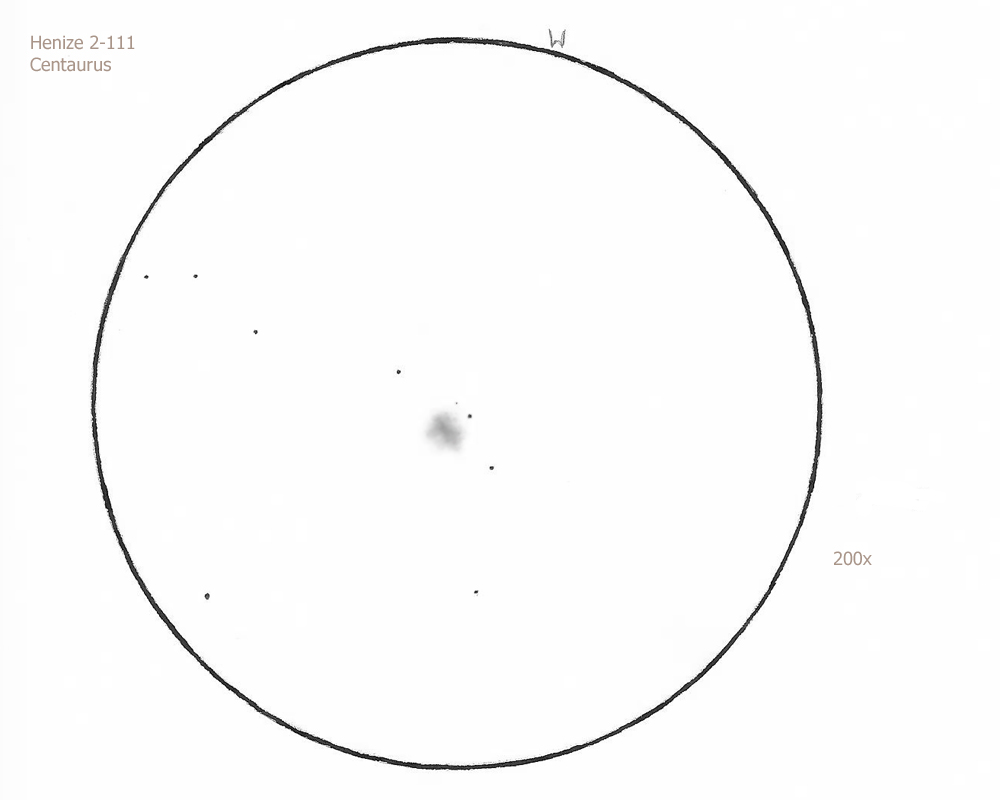
Here are some more sketches from that 1997 trip Down Under. These are some of the more obscure planetary nebulae I observed on that trip. All of these sketches were made at the 1997 Queensland Astrofest at Lions Camp Duckadang, Linville, Queensland on 25/26th and 26/27th August 1997. The scope I used was a 20 inch Dobsonian.

Henize 2-111, Centaurus


Henize 2-141, Norma


Henize 2-207, Ara


Longmore 16, Scorpius


Menzel 1 (PK 322-2.1), Norma
Shapley 1 (PK 329+02.1), Norma


PK 322-5.1, Triangulum Australe


The observatory is still not up yet. That is because our weather has gone completely to pot and is now more like that of October than it is of mid-July. There are gale-force winds, low temperatures (17C/63F) and rain. Plenty of rain. This will please the miserable buggers who have moaned about the heat and lack of rain and who have now got their own way but I hate this crap and want summer back as soon as possible. Apart from anything else, there's no observing to be had but even before the weather completely broke up we'd been stuck in a cycle of clear afternoons and cloudy nights for a couple of weeks.

I might have to rethink getting a big scope. I have not yet been able to find a permanent full-time job and the agency work has completely dried up, although I have some part-time seasonal work delivering tourist guides. I have an interview in two weeks' time for a part-time data-entry job which offers just over £6000 ($9000) and if I get that, which won't be enough on its own, I could at least combine it with the seasonal work. Unfortunately this seasonal job only lasts for the duration of the holiday season before dropping back to a few hours a week.
A 16" Meade Lightbridge, at +/- £1800 is not beyond my financial reach on part-time/low wages but a custom-built scope at just over £3100 is, as things stand. Maybe I should just get a LB and then go for a custom-built David Lukehurst Dob when/if my work and financial situation improves? LB's aren't bad scopes with a bit of tweaking, although their mirror boxes are incredibly heavy for the size of the scope. Hopefully, though, by the time I have managed to put away £1.8K things might have improved.

Thursday, 8 July 2010

From the notebooks - Australia 1997

I was going through old observing note books to scan in my sketches for my new website and I came across some from my observing trip to Australia in 1997. Those brought back some exciting and magical memories! I have decided to share some of the best ones here, as well as in their categories on my web site.
Click each image for a larger view.


NGC 5139, the great Omega Centauri. This 'King of the Globular Clusters' can be seen from southern Europe and the southern United States but has to be seen from the Southern Hemisphere in order to appreciate it in its full glory.
I looked at this wherever I went during both trips Downunder, from South America and also each time I have gone far enough south in the Northern Hemisphere to see it.
It's huge, slightly elliptical and has a curious footprint-shaped area of less star density or obscuring dust, just off-centre. Spectacular.

8" Cassegrain at 72x, Manly, Brisbane, Qld, Australia
August 11th, 1997


NGC 4755, the Jewel Box cluster in Crux.
This is my favourite star cluster, shaped like a capital 'A' and made up of blue and white stars of varying brightnesses but with a conspicuous red giant at the centre.

8" Celestron SCT, Alice Springs, NT, Australia
July 21st, 1997


NGC 6822, galaxy in Sagittarius. This is Barnard's Galaxy, a faint dwarf galaxy. The galaxy was a faint elliptical glow, quite faint against the background sky. Elongated 2:1 north-south with no central brightening.

20" Dobsonian at 60x. Lions Camp Duckadang, Linville, Qld, Australia
August 26th 1997


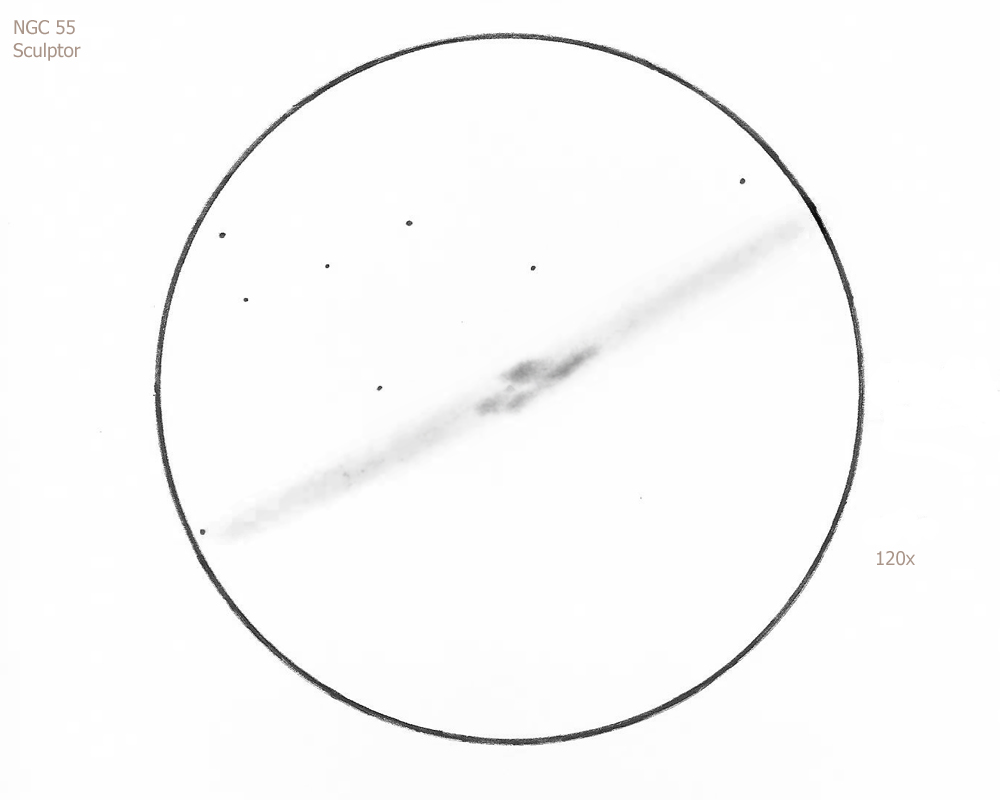
NGC 55, galaxy in Sculptor.
At -39 S, this is too low to be seen from England, even from the IW (our theoretical cut off is -40 but with atmospheric extinction, not a chance). Huge elongated galaxy with a very bright, mottled core. Only just fits into field of view at 120x.

12.5" Dall-Kirkham Cassegrain
Ellesmere, Qld, Australia
August 3rd 1997


NGC 7293, the Helix Nebula in Aquarius
I made two separate observations of this. One was from a rural site, the other from an urban one. Needless to say, I saw the nebula without an OIII filter more easily from the countryside than I did with a filter from the suburbs of Brisbane, where it was invisible. It was also 1st quarter Moon when I saw it in the suburbs.
Very large, oval ring with a low surface brightness and diffuse outer edges. No central star seen. Drawing made at the suburban site.
8" Cassegrain at 72x, Manly, Brisbane, Qld, Australia
August 11th, 1997

Monday, 5 July 2010

Some sketches from TSP

I have finally got round to scanning in various sketches, as I was doing a rebuild of my website and needed to scan pictures for it. Among these are some of the pics from this year's Texas Star Party. Click on each sketch for a larger image.

NGC 3245A, Leo Minor
Observed with Dennis Beckley's 18" Obsession at 258x.
Very thin and very faint. Pops into view with averted vision. Evenly bright throughout.
Prude Ranch, Ft. Davis, TX, USA

NGC 3279, Leo
18" Obsession, 258x
Bright, very thin, elongated.
Prude Ranch, Ft. Davis, TX, USA


NGC 3432,Leo Minor
18" Obsession, 258x
Very thin, irregular. Mottled, elongated centre.
Prude Ranch, Ft. Davis, TX, USA


NGC 5394 and 5395 (Arp 84), Canes Venatici.
48" Dobsonian
Very large and bright through the 48". Full of detail. 5395 is the larger of the two galaxies and is interacting with neighbour 5394. There is a bridge connecting the two galaxies. There is distortion in the spiral arms of 5395.
The Lowrey Observatory, Ft. Davis, TX, USA


NGC 3242, Hydra.
48" Dobsonian, 814x.
This is, like all eye candies, pretty nice in more modest apertures but is absolutely sensational in the eyepiece of 'Barbarella'. There are two green rings, the inner ring is more oval than the outer one and is thickened at each end while the outer one has a furry appearance. The central star is bright. Between the rings is 'gauzy' looking nebulosity which has a tinge of pink to it and the whole p.n. looks three-dimensional. I try not to write 'wow' in observing descriptions but...like, um...wow. As they say. Fabulous!
The Lowrey Observatory, Ft. Davis, TX, USA

NGC 4038 and 4039, Corvus
36" f/5 Obsession Dobsonian, 352x.
Very large and bright at 352x in the 36".
NGC 4038 is the thinner (uppermost in sketch) of the two galaxies. It is elongated and distorted with a brighter, mottled centre. NGC 4039 is fatter and not so elongated. It has bright HII regions and is very mottled. I can see 4039's tidal tail easily but 4038's is fainter and does not show up in the scan, although it is in the original sketch.
Prude Ranch, Ft. Davis, TX, USA


By the way, my website has been added to, with Messier galaxies the first observations up. Click here to visit the site.
I am getting itchy feet and am longing to visit Australia, or somewhere else south of the Equator, to see southern goodies again. Last year's visit Downunder wasn't the best for astronomy, although I wasn't actually on an astronomy trip, with the single opportunity I got for some serious observing washed out by storms and torrential rain during Australia's wettest and windiest winter for 25 years! However, any potential trips will have to wait until at least the end of 2011 as I want to get that 18" scope first!

Wednesday, 2 June 2010

TSP - The Objects: Part 4

Thursday 13th May. This was an attempt at another of Larry's Lists, this time the 'Rings Over Texas' list from 2000. Again, it was Alvin Huey, Dennis Beckley and myself observing with Dennis' 18 inch. The notes are quite very sparse as I was observing with the others and we were trying to get the list done against interference by clouds and - for ten minutes - by a skunk.

Conditions: Partially clear with some drifting cloud interfering, lightning to the north east.
Location: Prude Ranch, Fort Davis, TX.
NELM: 6.9
Seeing: II-III
Transparency: IV (when the drifting clouds were not in the way)
Instrument: 18 inch f4.5 Obsession dob. 17mm Ethos (121x), 13mm Ethos (158x), 11mm Plossl (187x), 6mm Ethos (343x)

NGC 2685, polar ring galaxy in UMa - Bright, with a elongated centre and an oval outer halo. Nice. 343x

NGC 5122, polar ring galaxy in Virgo - Faint, oval with a brighter centre. 187x.

NGC 2793, ring galaxy in Lynx - Faint and oval. Even brightness. 158x.

AM 1358-221, ring galaxy in Virgo - Quite faint at mag 15.8, oval.

MCG -4-33-27, ring galaxy in Virgo - Brighter than AM 1358-221. Small and oval. Next to a bright star.

Arp 87, NGC 3808, polar ring galaxy in Leo - Double galaxy next to a bright star: one, 3808A is larger than the other (3808B). Quite dim.

NGC 3861, polar ring galaxy in Abell 1367 (Leo) - bright, round, with a brighter centre. This was interrupted by a skunk wandering around; we abandoned the scope for a few minutes until he passed. I'll get the pun in before anyone else does - we were skunked!

Minkowski 1-64 (PK64+15.1), planetary nebula in Lyra - Round, well defined. Star just off northern edge. 343x.

II Hz 4, ring galaxy in Lynx - Adjacent to a star this is very faint and pops in and out of vision (more out than in!). Round.

NGC 4650A, polar ring galaxy in Centaurus - Elongated. Not very bright.

Mayall's Object (Arp 148), polar ring galaxy in UMa - Faint, elongated dim glow.

M57, central star - Nearly forgot this one! M57's central star was on the Rings Over Texas list and we got it without too much difficulty. It popped into view, looking very stellar, during moments of good seeing.

By this time, clouds were beginning to be a real nuisance so we packed up around 3am without observing all 25 objects needed for the pin; we observed around 14 of them although I only wrote down 12. As Alvin and I were going to be back at the 48" the following night we wouldn't get a chance to finish the list this TSP.

Alvin and I also managed to knock off the 2010 TSP Binocular Pin. Sat in adjacent chairs with our pairs of binoculars it was a case of 'yep' [write down the time]...'yep' [write down the time]...'yep' [write down the time]...and so on. Easy and just as much fun as the faint, esoteric stuff in its own way. A bit of light, hit-and-run astronomy.

Saturday, 29 May 2010

TSP - The Objects: Part 2

Tuesday 11th May was my second day at TSP, but I didn't do any observing at the ranch that night as I got invites from Jimi Lowrey and Alvin Huey (who was staying at Jimi's) to go and observe with them at the 48". This was far too good an opportunity to pass up and we had an awesome observing session with good transparency and periods of good seeing.
Obviously, using such a vast scope means that faint stuff becomes fair game and we wanted to view some esoteric objects but, of course we couldn't resist looking at some eye candy as well as the dim and distant.

Conditions: Clear, cool but not cold
NELM: 7.0+
Seeing: around II-IV
Transparency: Excellent, great detail and iridescence in Milky Way when it rose.
Instrument: 48 inch f4 Dobsonian. Eyepieces: Televue Ethos 17mm (287x), Zeiss ZAO-II 10mm (488x), Zeiss ZAO-II 6mm (814x), Zeiss ZAO-II 4mm (1220x).


NGC 3242, planetary nebula in Hydra - We started off with this lovely piece of eye candy. This is, like all eye candies, pretty nice in more modest apertures but is absolutely sensational in the eyepiece of 'Barbarella'. There are two green rings, the inner ring is more oval than the outer one and is thickened at each end while the outer one has a furry appearance. The central star is bright. Between the rings is 'gauzy' looking nebulosity which has a tinge of pink to it and the whole p.n. looks three-dimensional. I try not to write 'wow' in observing descriptions but...like, um...wow. As they say. Fabulous! 814x

IC 4277 and IC 4278, galaxies next to NGC 5195 - no description written down.

UGC 9242, galaxy in Bootes - Very flat, edge on. Mottled, with knots visible. Core not bright and the whole thing is fairly evenly bright across. 814x

Arp 84 in Canes Venatici - this is an interacting pair, NGC 5395 and NGC 5394 (the smaller of the two). Nicknamed the 'Heron' and it does look like that big water bird, this is very bright and detailed. NGC 5395 is huge in the eyepiece, elongated north-south, with a bright core and spiral arms which are somewhat distorted because of the interaction with 5394.
NGC 5394 is much smaller and is bright, with a slightly brighter centre. A tail of material is trailing from NGC 5394 and a bridge of stars can be seen linking the two galaxies. 814x

Arp 105 and Ambartsumian's Knot, galaxies in Ursa Major - This is a busy area, with several galaxies and other 'bits 'n' pieces. NGCs 3561 and 3561A are the brightest galaxies in the field, with quite bright MCG+5-27-12 and an anonymous galaxy nearby. A long very, very faint tidal tail stretches off to the north with a very faint knot, VV237f, at the end of it; I could see this some of the time with averted vision and had to look for a long time to be 100% certain it was there (this is on the famous AINTNO list but when we mentioned this to Barbara and Larry the following day at the ranch they were, to say the least, skeptical. Ok, they plain didn't believe us, which was a shame. :-(  ).
Ambarsumian's Knot, VV237b, lies immediately to the south of NGC 3561 and is visible as a faint, slightly elongated smudge of light.

VII Zwicky 466, galaxy in Draco - A ring galaxy, this is small and fairly faint but the ring structure is easily visible. Elongated. Inside the ring, it is evenly bright. The ring is slightly thicker on one side. There are three other galaxies nearby, one of which is edge on. 814x

QSO0957+561 A/B, quasar in Ursa Major - The Double Quasar, visually, isn't much to look at but knowing what it is, is what makes it exciting to observe. It is a gravitationally-lensed quasar, located 8.7 billion light years away, while the lensing galaxy itself is much closer at 3.7 billion light years.
Both components easily seen, looking like a fuzzy double star, and easily split during moments of good seeing with an obvious gap between them. I could see a hint of fuzziness around the quasar(s) which may, or may not, be the lensing galaxy (this is also on the AINTNO list but, again, we were met with disbelief. :-( ) 814x

The three quasars surrounding NGC 3842 in Leo - These are also on the (in)famous AINTNO List and we saw them. Not easily, but they were there. Looking for each in turn they each popped into view during moments of good seeing. Each was a tiny, stellar-looking pinprick of light.

The Jet in M87, in Virgo - Easily seen as a faint 'pencil' of light coming from the centre of the galaxy. The orientation of the field of view meant that the jet was located at '8 o'clock' from the nucleus. Another observing ambition realised. 814x

DHW 1-2, planetary nebula in Ophiuchus - Located between two bright stars. Oval, with brightening on one side. Unfiltered, the central star pops into view during moments of good seeing. 488x

NGC 6309, planetary nebula in Ophiuchus - Very bright and blue. Elongated and rectangular. Filaments seen at sides.

Rose 13 (Shakhbazian 19), galaxy group in Coma Berenices - A tight, faint group. Three components seen, one of which was very elongated. A difficult group. 814x.

As well as all the faint stuff, we got blown off the ladder with stunning views of M51, NGC 6543 (the Cat's Eye Nebula) and M17.


What a fantastic observing session with the giant scope. It's always a treat to be able to observe with scopes such as this and Larry's 36 inch, opportunities like this don't come along often and, when they do, they have to be made the most of and I think we did just that. As much as I love viewing 'lollipops' (don't we all?) I also love looking at faint, difficult objects that few people have ever heard of and even fewer have actually seen visually - that tidal tail from NGC 3561A down to VV237f is a case in point; it would seem that only three people in the whole world have ever visually seen it and that's myself, Alvin Huey and Jimi Lowrey!

We packed up at dawn and, due to tiredness plus the prospect of walking into the ranch (not a great distance but distinctly unappealing after an all-night sesh), we slept at Jimi's before returning to the ranch later that morning - and I have to say that Jimi's sofa is far more comfortable than the Prude bunks!

Finally, a quick note of caution - you have got to be careful when observing at the top of very tall ladders. It is not an experience for those of a nervous disposition and those scared of heights. I am not keen on heights, but I feel it is absolutely worth it for the views you get. However, I am very careful, as it would be easy to drop an eyepiece and hit someone or smash the eyepiece or, worse, to forget where you're putting your feet and take a tumble. I very nearly did that, when I overbalanced and nearly went 'a over t' from the very top of the ladder before just as quickly regaining my balance. A fall would have certainly resulted in broken bones and I very much doubt if my travel insurance would pay out for falling off a ladder while standing at the top of it, on tiptoes, in the dark, looking at a very faint object through a giant telescope.

Friday, 14 May 2010

TSP Day 4 - Thunderheads and the Skunk Nebula

The evening didn't start out too promising as, during the late afternoon huge thunderheads built up, dominating the eastern and north-eastern sky. At one point, there was one huge and evil-looking cloud that looked unpleasantly like a mushroom cloud, prompting people to make jokes that someone had dropped a nuclear bomb nearby. The effect of late sunlight on the cloud enhanced its hideous appearance and people were pleased when it began to lose its shape. No thunderstorm materialised, although there was some lightning on the horizon.

The skies weren't too great for observing, although useable, and by three a.m. we decided to pack up for the night which was a shame because we were just on halfway through another of Larry's Lists, this time the 2000 list 'Rings Over Texas'. Last night's observing was a mix of the frustrating (clouds right where you want to look, bad seeing, not being able to find things) and the hilarious - a visitation from a skunk who was on the lookout for dropped food items. Unfortunately the little cutie came far too close for comfort and we spent ten minutes keeping an eye out for him and, at one point, abandoned Dennis' 18" and retreated to a safe distance while Mr. Skunk pottered around. He investigated people's tents and my bag (and I was thinking 'please don't spray it, please don't spray it!') before wandering off somewhere into the darkness. We had to use dim red torches and averted vision to keep track of the Skunk Nebula but, luckily, he didn't deploy his chemical warfare on us so the area around us and, more importantly, our possessions remained Eau de Skunk free.

Back to the observing and before being 'skunked' (ha ha) by the clouds and deteriorating sky we managed to observe about 14 of the objects on the list:  NGC 2685, NGC 5122, NGC 2793, AM 1358-221,  MCG-4-33-27, Arp 87, NGC 3681, Minkowski 1-64, 2H24, NGC 4650A, the central star in M57 and Mayall's Object.

I also whipped quickly through the TSP Binocular list and added to my pin collection.

Going to bed at three a.m. at least meant I was able to get up early enough to go birding this morning and I saw some nice species, especially Blue Grosbeaks. I went up to Indian Lodge State Park with Keith Taggart of El Paso, TX and I got some (hopefully good) photos of different species at feeding areas specially set up. Unfortunately Vermilion Flycatchers, a species I'd particularly like to see are still eluding me at present. I am told they're common but to me that seems they're common when I am not about. That's the story of my life when birding!

TSP Day 2 - Aintnos and Ambartsumian's Knot among others

While observing on Monday night, Jimi Lowrey who is a friend of Alvin's and who I visited (along with some of the Houston gang) back in 2008 stopped by and invited me to join him and Alvin for a night on the 48". Obviously this was something not to be missed, especially as there were only going to be three of us - me, Jimi and Alvin - so just after 4pm Tuesday Alvin collected me and we headed up to Jimi's place at Limpia Crossing.
Just before dinner, Jimi and me headed over to fellow amateur Carl Swicky's place to see his 32". In the area, there are other observatories set up and there's a community of amateur astronomers. With the climate, dark skies, gorgeous birdlife and beautiful scenery I can't think of a better life, so if ever I win the UK lottery and get the chance to get out of that murky light-polluted place here is where I will come. We looked, admired and took plenty of pics (by the way, pictures will appear here but they might have to wait either until I get back to San Antonio on Sunday or when I get back to England -  I've just remembered that the World Cup begins next month, I'm looking forward to that, I love my football - on Thursday next week) including a prime focus capture of me in the 32" mirror.


After dinner, we headed up to Jimi's observatory, just up the hill from his house and set up 'Barbarella', his giant scope, for the night. The scope is collimated with huge bolts which need a torque wrench to turn and the laser collimater in the eyepiece can only be seen properly with a pair of binoculars!


Once the scope was set up and the mirror fans left to do their work (they suck air in and blow it out of the back of the mirror cell) we went back to the house to get our stuff and some supplies before returning to the observatory.


Fuller descriptions will appear later, but we observed quite a few objects, including NGC 3242 (aka the Ghost of Jupiter), UGC 9492, Arp 84, Arp 105 and Ambartsumian's Knot - including the Knot itself, the bridge between the galaxies and the streamer that comes away from the bottom galaxy. This latter component is on the famous Aintno List compiled by Barbara Wilson and Larry Mitchell but, sadly, Barbara doesn't believe us! I think Larry might, but he needs to see it for himself, he says.
Also seen were the ring galaxy VII Zwicky 466, the Double Quasar Q0957+561 A/B (nine billion light years distant, and I saw the very faint galaxy that is the gravitational lens - another Aintno, but we still can't weedle a certificate out of Larry and Barbara!), the Jet in M87 (a long-standing observing ambition of mine that I hadn't to date fulfilled, never got round to it. It was surprisingly easy but, then, I was using a 48" scope), the planetary nebula DHW 1-2, NGC 6304, the compact galaxy group Rose 13, very small and quite tough to seperate the components (I saw 3 members), NGC 5907 and NGC 6543, the Cat's Eye Nebula. We also saw three more quasars, but I need to find out what they're called and where they are as I forgot to write them down.
I'll pad this out with folks and scope photos and object descriptions later - 'later' might mean today, it might mean next week, but it will be in the near future.

The transparency was very good although the seeing was mediocre. However, we did get those moments of clarity which allowed quasars, etc, to pop into view. We packed up at 0500 and went back to the house where we all had a few hours' sleep before Alvin gave me a ride back to the Prude Ranch.

It was an awesome night and to see stuff that's totally impossible at home with a 12 inch is an opportunity you just can't refuse. Jimi, I doubt you read this,but if you do - thank you very much indeed for a wonderful night's observing! To read more about the Lowrey Observatory and Barbarella, Jimi's 48" Dob, here's his website: Lowrey Observatory. By the way, while you're there, go to the Gallery and the pic on the left side features me at the eyepiece, clinging on for dear life to the colossal ladder, taken in 2008.

Thursday, 15 April 2010

Observing 14th April 2010

Conditions:
Seeing II
Transparency III-IV - pretty 'milky' with some light scatter
Still, with no wind., although the slightest of breezes sprang up later.
Instrument: 12 inch f5 Dobsonian, 22mm Televue Panoptic (69x), 15mm Televue Plossl (101x), 8mm Televue Radian (190x), Lumicon OIII filter.

As the skies were really murky, and Virgo was washed out by the murk and a lot of light scatter in that direction, I decided to go to Draco for the Herschel 400 objects (and others) there instead. Things were a little awkward as Ursa Major was upside down and the charts difficult to relate to the sky without turning them upside down.

NGC 5866: Bright, fairly small. Elongated n-s, brightens gradually towards a diffuse centre. Bright star on one end and a slightly dimmer star on western edge. Dust lane? 190x

NGC 5907: Very thin, edge-on galaxy. Not much of a nuclear bulge, if any. Fairly faint, elongated n-s, quite large, stretching across field of view at 101x. 69x, 101x

NGC 5985: Very small and bright. Oval. Bright core, elongated n-s. 190x

NGC 5982: Very large oval galaxy, evenly bright, no brightening to middle. Slightly elongated, not face on. Looks like smudge or thumbprint. Very faint, not much brighter than background sky. 190x.

NGC 6543: Very bright and blue planetary nebula, even without the OIII filter. This was fairly easy to find, although at first I thought it would be too low, as the stars I was using to hop to it weren't that far above the trees in next door's garden. The OIII filter really brings it out. Small and round. Slightly fuzzy and definitely non-stellar at 69x.
At 190x it is uniformly bright with the middle being no brighter than the surrounding halo. No darkening anywhere within the nebula. 69x, 190x, OIII filter.

NGC 3147: This took a bit of finding, I had to star hop to it, using galaxies, rather than stars. I began with the easy to find M81/82 and went from there. 
Bright, round, with bright nucleus. 190x.

Because of work the next morning, I packed up at midnight BST. For a short session, it was a pretty good one, and I don't have to return to Draco for any Herschel 400 objects.

Observing April 11th and 12th 2010

At last! A clear night - or was it? It certainly began promisingly enough with the skies clearing off so I set up just before sunset in the hope that I'd get some observing done.
Unfortunately this state of affairs didn't last long and after the session began drifting clouds appeared and, as if in a devious conspiracy, they sat right where I aimed my scope. It seemed that when I moved to a different part of the sky they followed!
However, despite this, I managed to see the grand total of three objects on my H400 list.

Conditions:
Chilly +4C
Seeing III, Trans IV - Drifting clouds interfereing with observing, plus some high cirrus stuff
NELM 6.0
Instrument: 12 inch f5 Dobsonian; 22mm Televue Panoptic (69x), 15mm Televue Plossl (101x), 8mm Televue Radian (190x), Lumicon OIII filter

NGC 2392 - planetary nebula in Gemini: Easy to find. At 69x it's round, fuzzy with bright middle. It's a greenish-blue colour. OIII brings it out well. At 190x it looks very fuzzy with a very bright centre and a dark area between outer parts and centre. 69x, 190x OIII

NGC 2420 - open cluster in Gemini: Nice, fairly small o.c. Very rich and moderately bright. Irregular shape with c. 30 bright stars on a nebulous background which is many many unresolved stars. The brighter stars are all the same, or similar, brightnesses. 69x, 101x

NGC 5194 and NGC 5195 - galaxies in Canes Venatici: Fantastic. NGC 5194 (aka M51) is a large, face-on spiral. Spiral structure is easily seen and it has a big, bright nucleus.
The companion, NGC 5195, is much smaller. Round with a halo surrounding a bright core. 69x, 101x.

At this point, the clouds were becoming more than just an irritation, they were becoming a damned nuisance, so I packed in. As I came back outside to pick up the scope base, the clouds had filled the sky.

-------------------------------------------------------------------------------------------------------------------------------------

The following night, 12th April, wasn't totally clear, so I didn't even bother carrying the scope out but, instead, decided to bag Melotte 111, the Coma Star Cluster, with my 8x42 binoculars. Mel 111 is on the AL Binocular Deep Sky list, which, apart from four objects in Cepheus and Lacerta, I have just about finished.
Easily seen with the naked eye, this huge open cluster is pretty spectacular in binoculars. It is harp-shaped, with 15 bright stars outlining the shape of the harp. There are many more fainter stars in among the brighter ones. The stars are all blue-white and the brightest ones all the same magnitude. Nice.

Friday, 19 March 2010

Observing, March 15th 2010

Skies were looking good the other evening, so I dragged out the 12 inch for a Herschel session. On setting it up, though, I found the alignment was out, way out in fact, which was annoying and a problem that the new collimation springs I'd bought for it was supposed to prevent. However, I put the problem down to the fact that I'd resorted to transporting the heavy and awkward tube into the garden with a sack trolley which must have knocked the mirror and cell.

Once I'd sorted that out, I left it to cool and went inside to help my aunt with some sorting out of stuff she wanted done (the house is being re-arranged and a massive chuck-out is going on), badly slashing my thumb in the process, while trying to take down a burnt-out light fitting, and having to get it bandaged up - with my aunt on crutches after a foot operation the kitchen looked like A&E - but once this was done, the observing began.

Date 15th March 2010
Time: 2045 - 2300 UT
Conditions: chilly (around 1C), misty, no wind
Seeing: I-II
Transparency: III
NELM: 5.8-6.0 (mist causing light scatter)
Equipment: 12 inch f5 Dobsonian, 22mm Televue Panoptic (69x), 11mm Televue Plossl (138x), 8mm Televue Radian (190x) and OIII filter

First up, into Leo where NGCs 3607 and 3608 made a nice pair in the same field of view of the 22mm Panoptic. Also in the f.o.v. was NGC 3599 which is a lot fainter.

NGC 3607, galaxy in Leo - bright, oval suddenly brightens to a very bright nucleus. 69x, 138x.

NGC 3608, galaxy in Leo - slightly fainter than 3607. Also oval with slightly brighter centre. 69x, 138x.

NGC 3955, galaxy in Leo - considerably fainter than the other two, oval. Non-Herschel.  69x, 138x.

NGC 3626, galaxy in Leo - smaller than 3607/8, fainter, elongated north-south. Brightens towards centre to a bright nucleus. 69x, 138x.

NGC 3655, galaxy in Leo - elongated north-south. Brightens gradually to non-stellar core. Fairly bright, small, oval. Well defined against background sky. 69x, 138x

NGC 2903, galaxy in Leo - very bright and easy to find. Elongated north-south, oval. Slight hint of spiral structure. Brightens to very bright, almost stellar, nucleus. Nice! One I want to return to on a better night. 69x, 138x.

NGC 3344, galaxy in Leo Minor - round, almost even glow, brightening slightly towards middle. Two bright foreground stars are in the eastern half of the galaxy. 69x. 138x.

NGC 2859, galaxy in Leo Minor - small, round, with quite faint outer halo. Brightens considerably to very bright core. 69x, 138x.

NGC 2782, galaxy in Lynx - round. Not bright. Brightens gradually towards a compact core. 69x, 138x.

NGC 2371/2, planetary nebulae in Gemini - at 69x looks elongated with a distinctly 'figure of 8' look about it, or looking like a peanut. At medium power (138x) the two lobes are very obvious and one lobe (the western one) is much brighter than it's neighbour. At higher power (190x - highest I could go to on such a crummy night and with my collimation a bit out) the appearance is of two ovals adjacent to each other, each elongated approx. north-south. 69x, 138x, 190x + OIII filter.

NGC 2419, globular cluster in Lynx - round, even glow with no condensation. Nicely marked out by three bright stars in an arc pointing straight at it. Moderately bright, well defined against background sky. No stars resolved. although with averted vision some granulation (hinting at stars) appears.  69x, 138x, 190x.

Reluctantly packed up at 2300 UT; I would have gone on for a lot longer, only I had to be up at 0600 for work the following morning. It was a good session, better than I expected, despite the crummy conditions and my poor throbbing, massacred, thumb. I have now crept up to 11% of Herschels observed in the initial 400 list.

Tuesday, 16 March 2010

IWSP - observing

Here on the Isle of Wight we are fortunate in that we have a southerly aspect with unobstructed and un-lightpolluted views out over the English Channel, from the island's south coast where the star party is held. The only source of light pollution are passing ships and the light houses at St Catherines Point and Portland Bill (unlike the north east part of the island which is as light polluted as anywhere on the UK mainland).
This year's IW Star Party had a mix of cloud and clear spells, on the nights I was there, Friday and Saturday. Friday night was clear for an hour, then the weather closed in again and it rained for the rest of the night. Saturday was a lot better, giving us a good couple of hours and what I hear about Sunday was that it was clear for the most part, but I had to miss it because of having to be at work on Monday morning.

I was fortunate enough to share Owen Brazell's 20 inch Obsession, as well as take peeks though other people's scopes including a rather nice Orion Optics UK 14 inch Dob (which has a same length, but lighter, tube than my 12"), here are the observations all made with the 20 inch. These aren't in order, as I was scribbling the notes down on Post-it notes, a pad of which happened to be in my pocket - unlike a notebook - and they got mixed up.


Date: 13th March 2010
Conditions: chilly, cold breeze, some high cloud. No Moon.
NELM: 6.3
Seeing: Ant I-II
Instrument: 20 inch f5 Obsession Dobsonian, 21mm Televue Ethos, 13mm Televue Ethos, 8mm Televue Ethos and OIII filter.

M42 in Orion: I've seen this in every instrument I have looked through but this was the best view I have ever had. So much detail, wisps, tendrils, dark areas...and the Trapezium was as detailed as ever I've seen it. You could clearly see the hole, caused by the young stars blowing the gas away from their surroundings. The E and F components were easily seen, as were much fainter stars in the nebulosity immediately surrounding the Trapezium.

Jonckheere 900, planetary nebula in Gemini: Small, round and fuzzy. Quite bright. 318x + OIII

Jonckheere 320, planetary nebula in Orion: I have tried for this with my 12 inch from home without success. In the 20 inch it is small, not quite stellar, round and has a fuzzy appearance, this fuzziness preventing it appearing stellar. 318x + OIII

B33/IC 434 (Horsehead Nebula) in Orion: At last! I have made numerous attempts to see this, with no success. However, I suggested to Owen that we have a crack at this, so he put the 13mm Ethos and a HBeta filter in and we saw it comparatively easily. B33 (the Horsehead) stood out against IC434, as a large, dark, semicircular area cutting into the ribbon of IC434. With averted vision, we could just make out the horse's nose. For me, this was the observation - and the highlight - of the weekend. 120x

Abell 21 (aka Medusa Nebula) planetary nebula in Gemini: Eastern side is the brighter and is crescent shaped, in fact almost triangular. There is also some nebulosity on the western side. (Magnification unknown) + OIII

NGC 2022, planetary nebula in Orion: Oval, bright and slightly darker in middle. 318x + OIII.

NGC 2683, galaxy in Lynx: Large, bright edge-on spiral. Brightens beautifully towards centre.

NGC 2371-2, planetary nebula in Gemini. This is a very interesting planetary, consisting of two lobes, the western lobe being the brighter of the two. It does look like its nickname of the 'peanut' nebula, especially at low power. 318x + OIII

NGC 3242, (nickname Ghost of Jupiter) planetary nebula in Hydra: Very bright, oval with brighter middle. 318x + OIII

The clouds rolled in again just after midnight, so after a talk, I headed back to my tent (although I ended up abandoning it due to the cold!). It was a short, but good, session and the undoubted highlight was seeing the Horsehead Nebula for the first time as well as M42 in such incredible detail.


Monday, 4 January 2010

Life - and observing - in the freezer

Or 'Christ, it's cold!' could be a subtitle. The UK, unusually, has been in the grip of subzero temperatures for a couple of weeks now, with daytime temperatures barely getting above zero and night-time ones plummeting down to minus ten or colder. A lot of the country has got snow - except us on the South Coast, fortunately (or is that 'unfortunately'? If you have to have precipitation of some form, at least let it be of the picturesque-but-not-a-chance-of-getting-to-work-today type), instead we have had sleet, freezing rain and black ice making lethal driving conditions...and a few clear nights. In fact, 2010 is off to a flying start and out of four nights I have had three observing sessions, two binocular and one telescopic.
Tonight was the telescopic night. The Moon, which is 77% of Full, wasn't to rise until 2131 GMT so when I arrived home from work, via a doctor's appointment, I set my scope up and left it to cool for an hour.

Conditions:
Very cold -6C, No wind, icy underfoot (frozen dog pee!)

No Moon (rose at 2131 GMT)
Seeing Ant III-IV, transparency II
NELM 6.2
Instrument: 12 inch (30 cm) f5 Dobsonian

I will update this post when I get home from work tomorrow, with the objects I observed, except for Abell 12 which I'll mention now. I reobserved it this evening and this time it DID pop out with the OIII filter, as described by numerous people. I know, such a doubting Thomas...
Other objects I did observe were NGC 1514, a planetary nebula in Taurus, NGC 1980, NGC 1981 and NGC 2024 (a poorer view than the one I had a couple of weeks ago - if the Flame's crap, don't even bother looking for the Horsehead). I also looked for Abell 4 in Perseus and didn't find it, although it is fairly near the bright open cluster M34, but I really need to download some charts with that in, as it wasn't on my Sky Atlas 2000.0 (didn't try Uranometria, though). Not a hefty return from an evening's observing, admittedly, but I wasn't out there that long, too bloody cold.

NGC 1514, planetary nebula in Taurus. This was a piece of cake to find. At low power, and at first glance it looks like a bright, if fuzzy, star - indeed this is the 9th magnitude central star - but with averted vision a halo of fuzz pops out at you. Popping in the OIII filter really brings it out. At a higher power (190x), I could see darker areas between the outer halo and the central star and there are brighter areas in the halo itself. Slightly elliptical. As well as the central star, there is a much fainter, smaller, star next to it probably a foreground star. 61x, 190x + OIII

NGC 1980, open cluster in Orion. North of M42 this is a nice open cluster which is richer than nearby NGC 1981. I counted around 31 stars of which 10 are fairly bright, All the stars are white. 38x

NGC 1981, open cluster in Orion. Beautiful but sparse. Dominated by very bright white star plus a slightly fainter double which is also white, plus 17 other, much fainter, stars. 61x

I couldn't track down Jonckheere 320 again, but as I was having problems with the icing up of my finders I will give that another go before the end of the winter. I have read reports of it being seen in a 10 inch under comparable sky so there's no reason I shouldn't see it.

It was 'one of those' sessions again - my OIII filter fell to bits, a retaining ring-type object dropped out of it and the thing just fell apart. Fortunately I screwed it back together again, only to drop it onto the concrete of the patio five minutes later with, luckily, no harm done. I also dropped eyepieces, charts and gloves, but that's because, despite gloves, my hands were a bit cold. I was definitely fortunate in that nothing actually broke; fell apart yes, but actually broke as in completely destroyed, no.

I packed up just after 9pm, and after bending over the eyepiece (my final objects of this short session were in southern Orion) I couldn't straighten up properly, a combination of lower back pain and stiffness due to cold and bad posture from being hunched over the eyepiece meant that I shuffled indoors to warm up looking like the Missing Link between humans and apes - that almost-knuckle-dragging stance of something that can't quite walk upright... Once the Missing Link phase had passed I carted everything back in, pleased I had done some observing, but not too pleased that I didn't do as much as I had intended.

I'll chuck in the descriptions tomorrow and maybe a drawing or two, if I get them tarted up and scanned in, which is a tad unlikely as I don't get in from work until nearly 6pm and if it is clear again I'll be observing.